
Tax · 6 min read
Paid in USDT as a Freelancer in India? How to Convert It to INR and Pay Tax
Freelancer in India paid in USDT? How to convert it to INR without P2P, what records to keep, and how it's taxed: slab rate on receipt, 30% on gains.
By Bryan Aaron · Updated
Quick answer
Get paid in USDT on TRC20 to your own wallet, then sell it through a business, an Indian exchange or a direct offramp like Disburz, not P2P buyers. Most CAs tax the INR value on the day you receive it as freelance income at your slab rate, and any later gain when you sell at a flat 30%.
More Indian freelancers, developers and remote workers are getting paid in USDT by foreign clients and DAOs. Getting the USDT is easy. The questions start after: how do you turn it into rupees without a P2P stranger, and how much tax do you pay? This guide answers both, in the order you'll hit them.
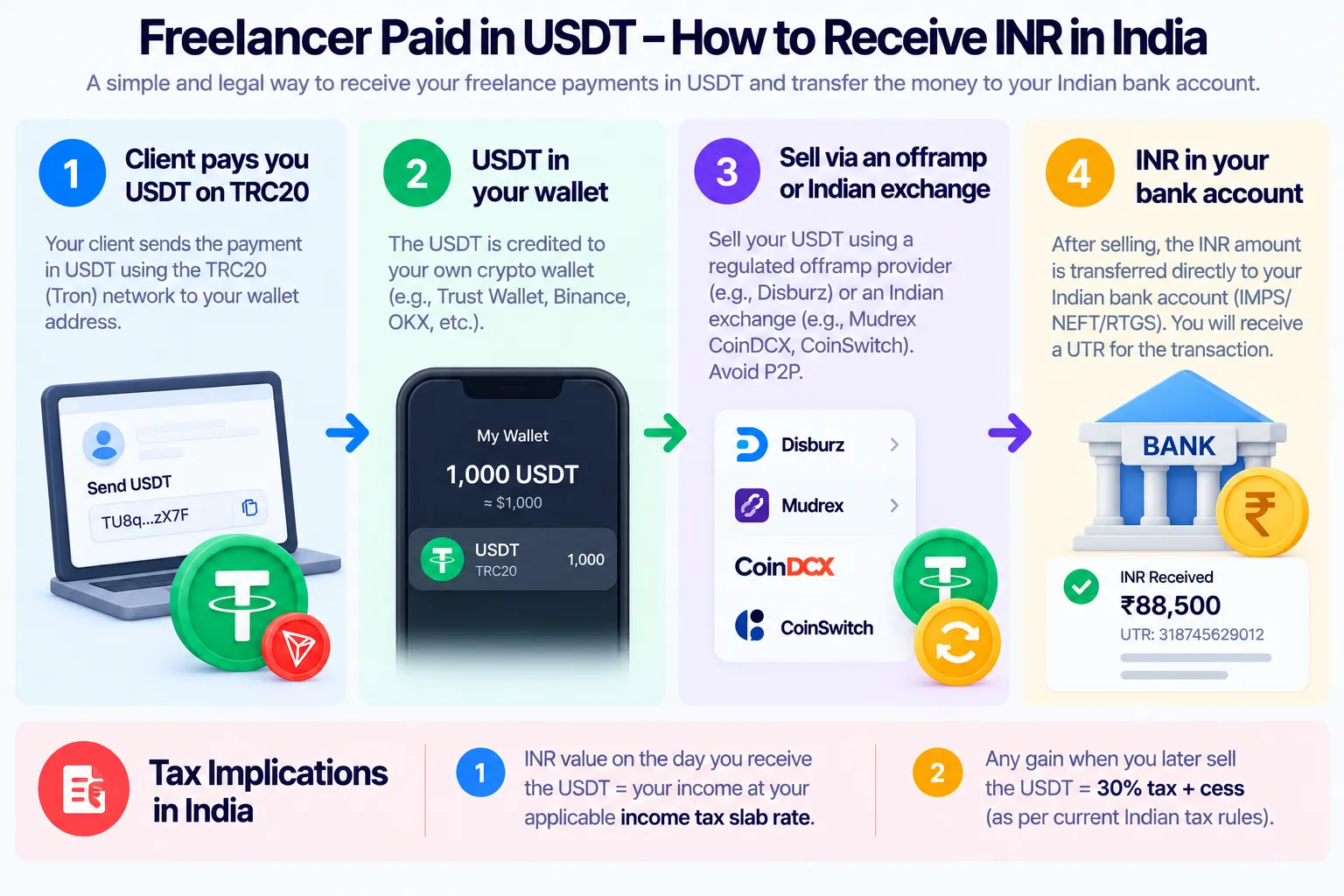
Step 1: Get paid on the right network
Ask your client to send USDT on TRC20 (Tron) if they can. It's cheap and fast to send, and it's the network Disburz accepts today. Give them an address from your own wallet (Trust Wallet, for example) or your exchange account, and confirm the network in writing before the first payment. Paying on the wrong network is the most common way freelancers lose money; see sent crypto on the wrong network?
Step 2: Convert USDT to INR without P2P
You have two clean routes:
- An Indian exchange. Complete KYC, deposit the USDT, sell it for INR and withdraw to your bank. Exchanges deduct 1% TDS on the sale.
- A direct offramp like Disburz. Send USDT from your wallet and receive INR straight in your bank account by IMPS, NEFT or RTGS, with a bank UTR. No documents to upload. Today it costs ₹50 fee + 3 USDT network deduction, about 0.70% (₹338.00) on a 500 USDT payment. See the live rate on USDT to INR.
Avoid selling client payments on P2P. The rupees come from an unknown buyer, and if that money is linked to a scam, your bank account can be frozen, which is the last thing you need when it's also where your income lands. More in how to sell USDT without P2P.
Paid as an esports player or streamer? See esports prize money in USDT.
Step 3: Keep a record of every payment
- The invoice you raised to the client, in USD or INR.
- The transaction hash of each USDT payment you received, and the date.
- The INR value on the day you received it (save the rate you used).
- Your sale: the order details, INR received and the bank UTR.
This is the paper trail a CA needs, and what your bank may ask for if it questions a credit. A UTR on every payout makes it easy to match each sale to a bank credit.
Step 4: How freelance income in USDT is taxed
Most CAs split it into two events:
- When you receive the USDT, it's payment for your services. Its INR value on that day is your professional or business income, taxed at your normal slab rate, not at 30%.
- When you sell the USDT, any gain over that value is a gain on a virtual digital asset, taxed at a flat 30% plus cess. Losses can't be set off. If you sell soon after receiving it, the gain is usually small.
Freelancers usually file ITR-3 (or ITR-4 under presumptive taxation, if your CA agrees it fits) and also fill in the VDA schedule for the sale. If 1% TDS was deducted when you sold, it shows in your Form 26AS / AIS and counts towards your tax. Full rules are in crypto tax and TDS in India.
What about GST?
If you're registered for GST, exports of services usually qualify as zero-rated only when payment arrives in convertible foreign exchange through banking channels. Payment in crypto may not meet that test. If GST applies to you, settle this with your CA before you take large payments in USDT.
The short version
Get paid on TRC20 to your own wallet, convert through a business rather than P2P, keep the transaction hash and UTR for every payment, and file the receipt as income and the sale as a VDA transfer. To see what a payment is worth in rupees right now, use the USDT to INR calculator.