
Safety · 7 min read
How to Sell USDT Without P2P in India (2026)
Sell USDT for INR without P2P buyers, including from Binance: Indian exchanges, OTC desks and direct offramps compared on fees, speed and freeze risk.
By Bryan Aaron · Updated
You can sell USDT for rupees without ever dealing with a P2P buyer. There are three ways: sell on an Indian exchange and withdraw INR, use an OTC desk for large amounts, or send USDT to a direct offramp that pays your bank. What they share is the thing that keeps your account safe: the rupees come from one known business, not a stranger.
Disburz is one of these routes, and it’s our product. We’ve tried to be fair, and we say where the others beat us.
Quick answer
- Your USDT is already on an Indian exchange and you’ve done its KYC? Sell there and withdraw INR. Simple.
- Your USDT is in a wallet (Trust Wallet, TronLink) or a global exchange? A direct offramp saves you the deposit-sell-withdraw loop. See Trust Wallet to bank account and Binance to an Indian bank account.
- Selling ₹25 lakh or more? Talk to an OTC desk and settle by RTGS.
Why avoid P2P in the first place?
In a P2P trade the rupees land in your account from someone you’ve never met. If that money came from a fraud — and some of it does — the victim complains, the cyber cell traces the money, and banks are asked to freeze every account it passed through. Yours included. You did nothing wrong, and it can still take weeks to fix.
We’ve written a full guide on what to do if it happens: bank account frozen after a P2P crypto trade. The rest of this page is about not getting there.
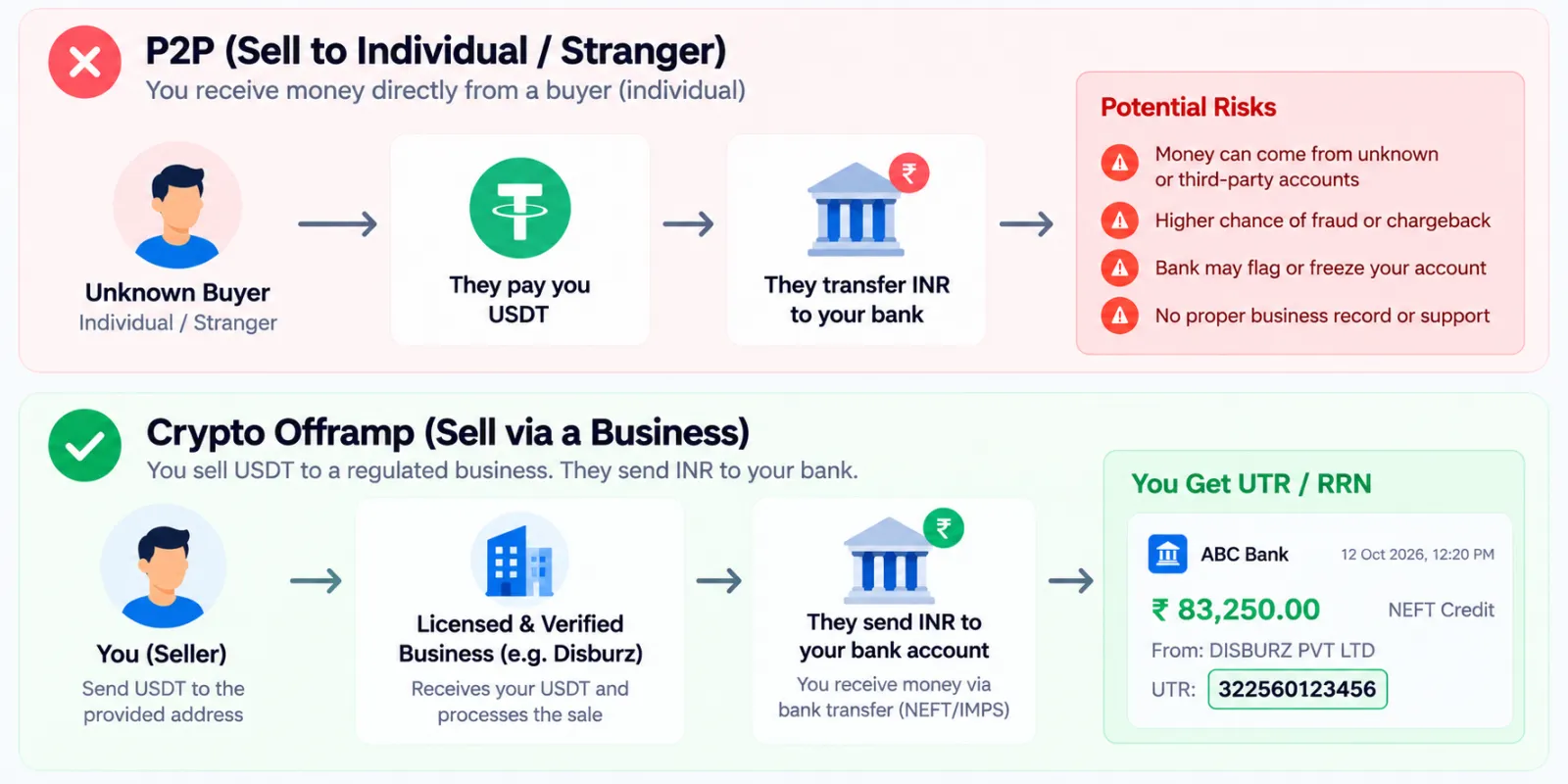
The non-P2P routes side by side
| Indian exchange | Direct offramp (Disburz) | OTC desk | |
|---|---|---|---|
| Who pays you | The exchange | Our payout partner, Trans Ramp | The desk |
| Steps to reach your bank | Deposit → sell → withdraw INR | Quote → send USDT → INR in bank | Call → agree rate → send → paid |
| Where the cost is | Spread, trading fee, INR withdrawal fee | ₹50 fee + 3 USDT network deduction, shown upfront | Negotiated spread |
| Documents | Full KYC on the exchange | No ID upload on Disburz; Trans Ramp runs its own checks | Business-style KYC |
| Best for | USDT already on that exchange | USDT in a wallet, ₹1,000 to a few lakh | Large amounts |
| Proof of payment | Exchange statement | Bank UTR, emailed to you | Bank UTR |
Fees as of October 2026. Exchange fees vary by platform; check the final INR on their withdrawal screen.
Route 1: an Indian exchange
If your USDT already sits on an Indian exchange and your KYC is done, this is the least effort. Sell USDT for INR on the exchange, then withdraw INR to your bank. Two things to check first: that the exchange is registered with FIU-IND, and what it charges to withdraw INR — that fee and the spread are where the cost hides, not in the headline rate.
Watch out for exchanges whose “INR” option is actually P2P under the hood. If you’re matched with a buyer who pays you by bank transfer or UPI, it’s P2P, whatever the button says.
Route 2: a direct offramp
An offramp takes your USDT and pays rupees into your bank. You don’t trade on an order book and you don’t withdraw anything. On Disburz it works like this:
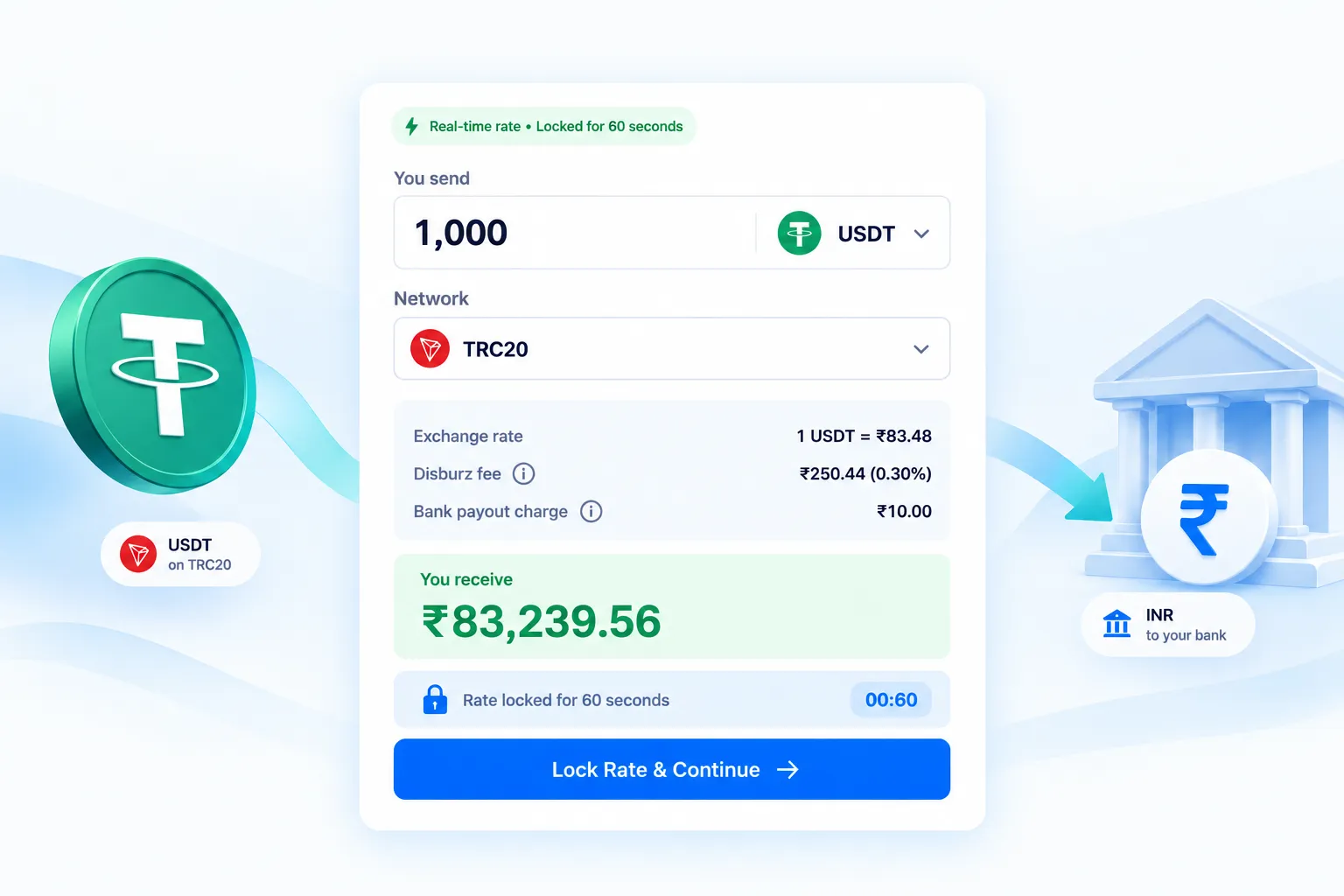
- Get a quote. Log in, enter the USDT amount and add your bank account. You see the rate, both fees and the exact INR before you commit.
- Confirm and send. The rate locks. Trans Ramp’s payment page opens with an address and a QR code. Send USDT on the TRC20 (Tron) network within 30 minutes.
- Watch it confirm. The page shows “Payment detected” and the block confirmations, 1/19 to 19/19. That usually takes about a minute.
- Get paid. Trans Ramp sends INR by IMPS, NEFT or RTGS. You get one email when your USDT arrives and another with the bank reference (UTR) when the rupees are sent.
Worked example (October 2026): you sell 1,000 USDT at ₹96. Trans Ramp deducts 3 USDT, so 997 USDT is converted: 997 × 96 = ₹95,712. Minus the ₹50 fee, ₹95,662 reaches your bank. Check today’s numbers on the USDT to INR page.
Route 3: an OTC desk
For ₹25 lakh and up, a desk will quote you a rate by phone or chat, and you settle by RTGS. You give up the instant quote in exchange for a better spread on size. It’s overkill for ₹50,000.
How to check any platform before you send
- Who sends the rupees? It should be the platform or its named partner — never “a buyer”.
- Do you see the final INR before sending? Not just a rate — the amount after every fee.
- Do you get a UTR? It’s your proof the bank transfer happened. What a UTR is.
- Can you reach a person? A ticket system, an email, a real Telegram handle.
Mistakes that cost people money
- Comparing headline rates instead of the INR that actually reaches the bank.
- Sending on the wrong network to save a few rupees in fees.
- Accepting a “trusted buyer” from a Telegram group. That’s P2P with extra steps.
- Selling in many small P2P trades to stay under the radar — it multiplies the freeze risk.
- Meeting a local exchanger for cash. There's a ₹2 lakh legal limit and a real robbery risk; see selling USDT for cash in India.
Next: compare all four routes, including P2P, in the best way to sell USDT in India, or get a live quote.