
Settlement · 4 min read
How Long Does USDT to INR Settlement Take?
How long it takes to convert USDT to INR and receive money in your bank — network confirmations, processing and IMPS / NEFT / RTGS timelines explained.
By Bryan Aaron · Updated
Quick answer
Selling USDT for INR takes three steps: the blockchain confirms your transfer (about a minute on Tron), the order is checked and converted (usually seconds), and the bank transfer is sent. With IMPS, most payouts reach your bank within a few minutes of on-chain confirmation, and you get a UTR as proof.
The time between sending USDT and seeing INR in your bank has three parts: the blockchain confirming your transfer, Disburz processing the order, and the bank transfer itself. With Disburz, most transactions settle in under 2 minutes once the crypto is confirmed on-chain.
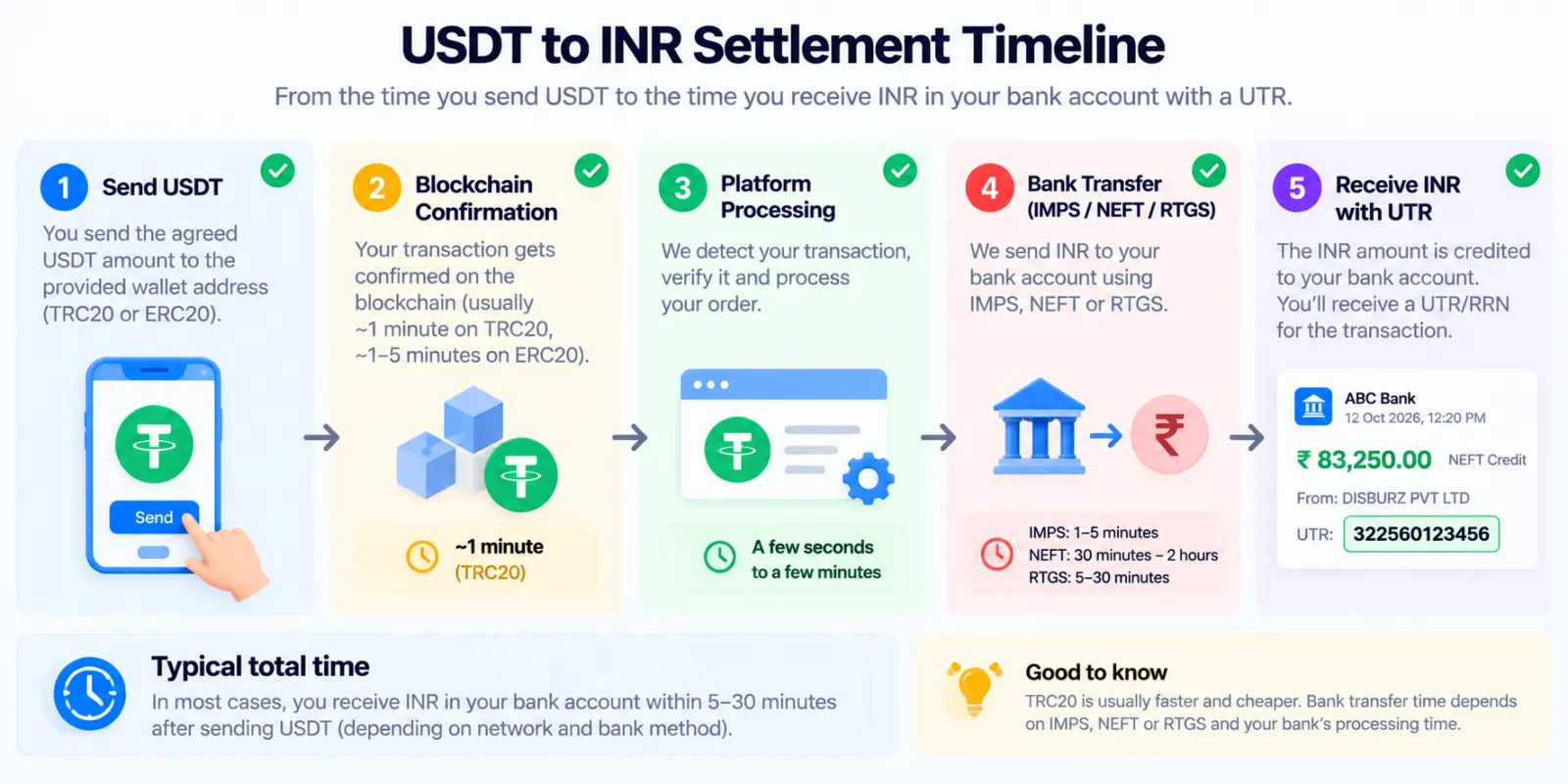
1. On-chain confirmation
| Network | Confirmations required | Typical time |
|---|---|---|
| Solana | 32 | Under 1 minute |
| TRC20 (Tron) | 20 | About 1 minute |
| BSC (BEP20) | 15 | About 1 minute |
| Base / Arbitrum | 12 | About 1 minute |
| Polygon | 64 | About 2 minutes |
| ERC20 (Ethereum) | 12 | About 3 minutes |
| Bitcoin | 2 | About 20 minutes |
Busy network periods can take longer. Your order page shows confirmations in real time.
2. Verification and conversion
Automated checks run as soon as the deposit is confirmed, then the locked rate is applied. This normally takes seconds. Occasionally a transaction is held for a manual review — if so, support will contact you.
3. Bank transfer
- IMPS: near-instant, 24/7, including weekends and bank holidays.
- NEFT — settles in half-hourly batches, 24/7.
- RTGS: for ₹2,00,000 and above; real-time, 24/7.
When the transfer completes you get the UTR number. If the money isn't visible yet, share the UTR with your bank — it is proof the payment was sent.
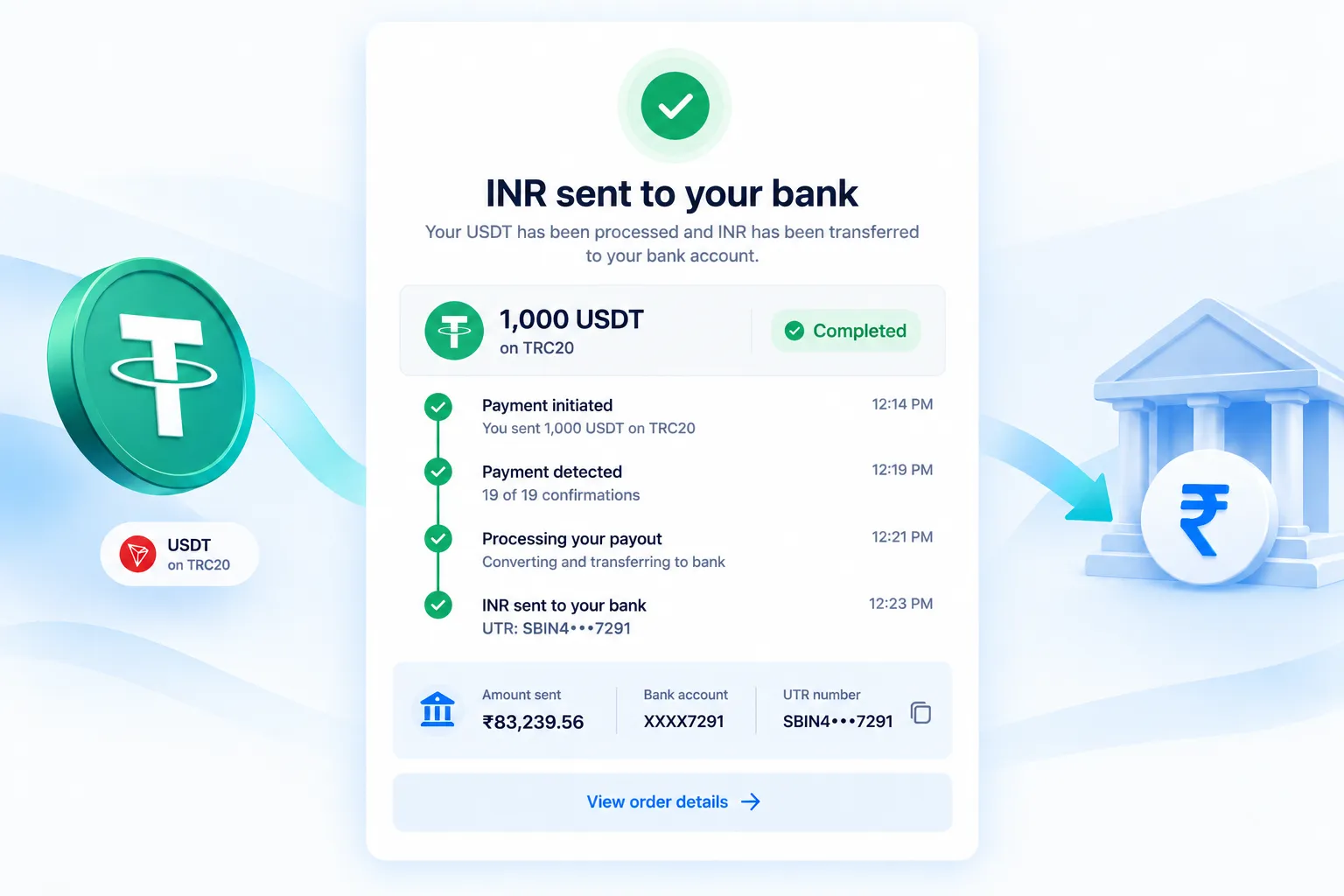
What slows things down
- Sending a different amount from the order, or after the rate lock expired.
- Sending on a different network than selected.
- Bank-side delays or maintenance windows at the receiving bank.
- A new bank account that hasn't been verified yet.