Settlement · 5 min read
What Is a UTR Number? How to Find and Use It (IMPS, NEFT, RTGS)
A UTR is the bank's reference for one IMPS, NEFT or RTGS transfer. What it looks like, where to find it in your bank app and how to use it when money is late.
By Bryan Aaron · Updated
A UTR (Unique Transaction Reference) is the number the banking system gives one bank transfer. Every IMPS, NEFT and RTGS payment has one, and it’s the same at the bank that sent the money and the bank that received it. That makes it the best proof a payment was made: with the UTR, either bank can find the exact transfer in seconds.
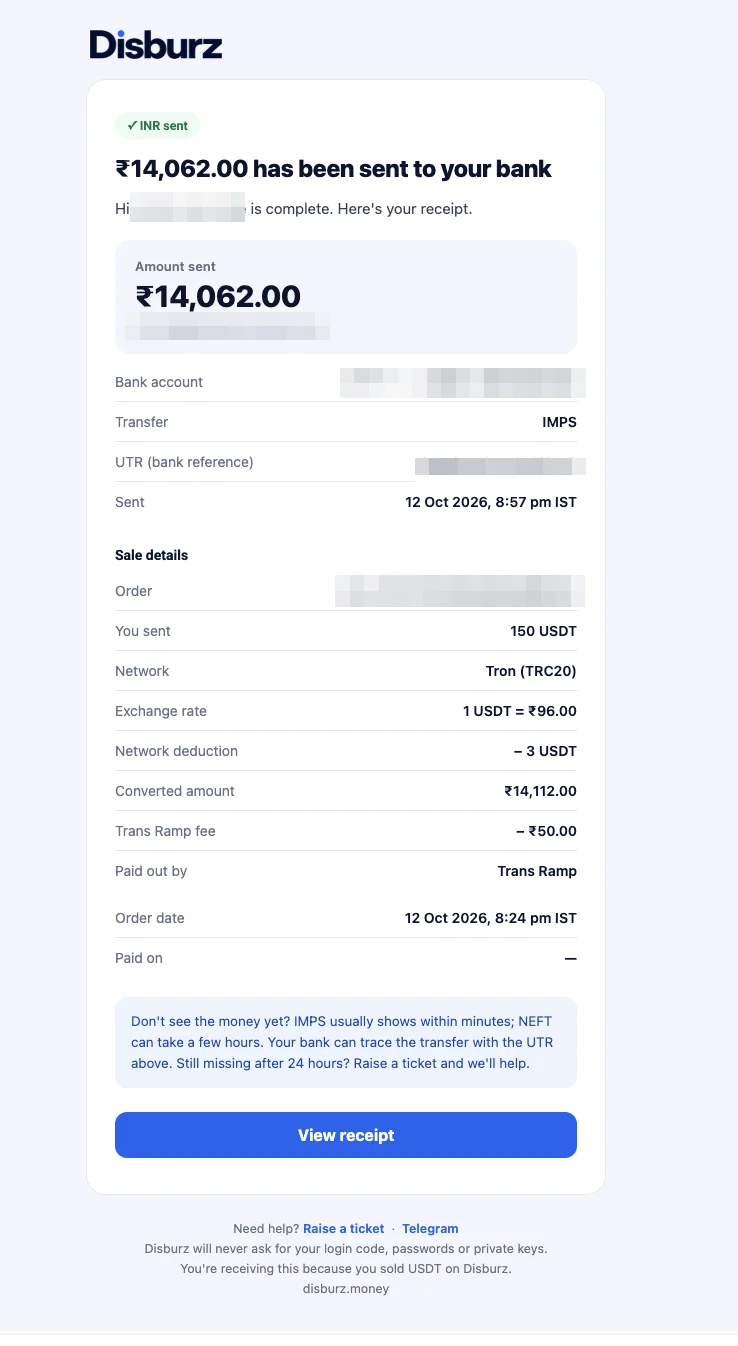
When you sell crypto on Disburz, our payout partner Trans Ramp emails you the UTR as soon as your rupees are sent.
Quick answer
- What it is: the bank’s reference for one transfer, not your account number or the order number.
- Where to find it: the transaction details or statement narration in your bank app.
- What to do with it: give it to your bank if a credit is missing. They can trace it.
What does a UTR look like?
The format depends on how the money was sent:
| Method | Usual format | Often labelled |
|---|---|---|
| IMPS | 12 digits | IMPS ref, RRN, UTR |
| NEFT | 16 characters, starting with the sending bank’s 4-letter code | UTR, NEFT ref |
| RTGS | 22 characters, starting with the sending bank’s 4-letter code | UTR, RTGS ref |
| UPI | 12 digits | UPI ref no., UPI transaction ID |
Banks don’t all show it the same way, so treat these as typical rather than fixed. If a number on your statement is tied to one specific credit and isn’t your account number, it’s almost certainly the reference.
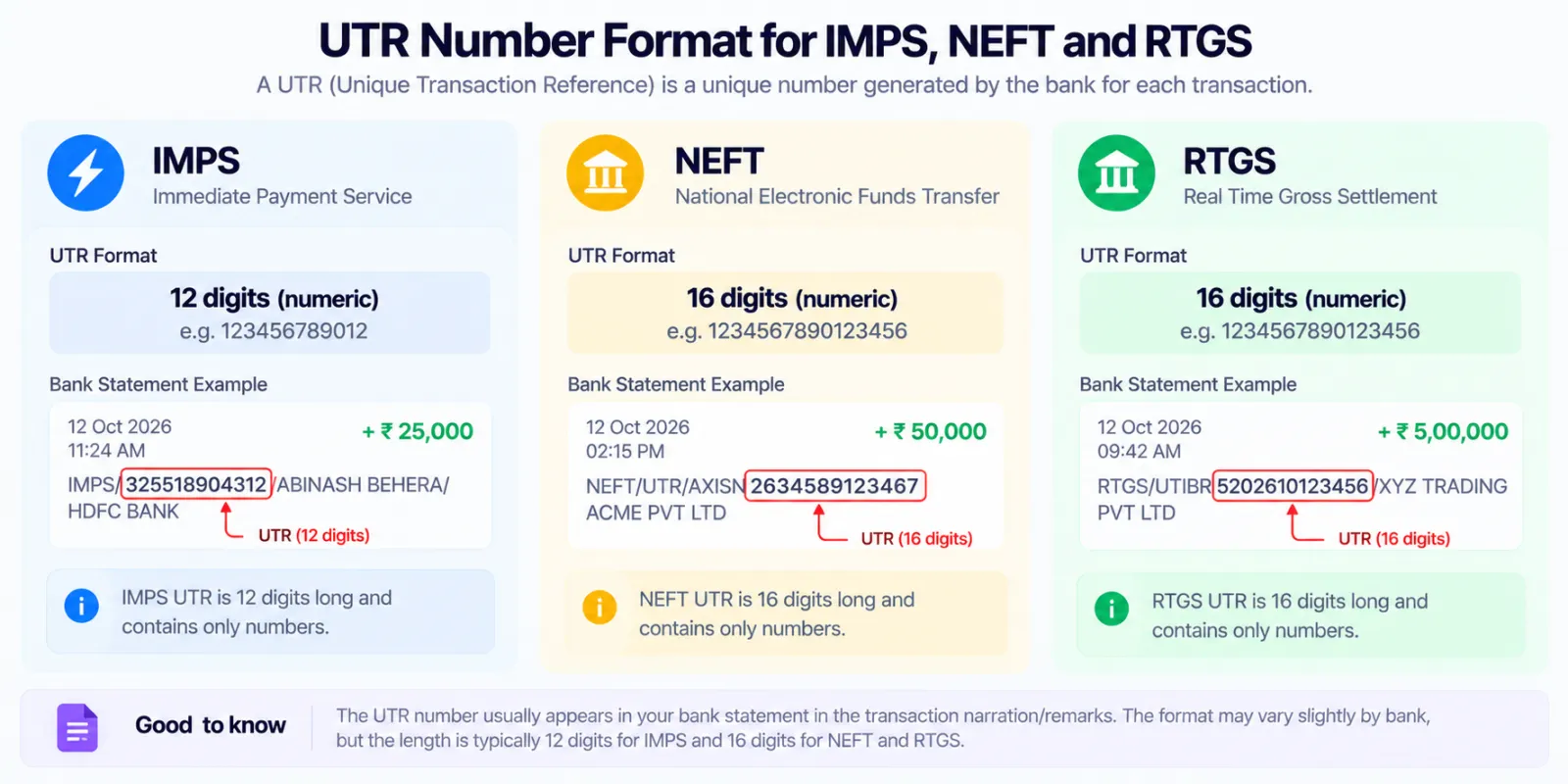
Which transfer type you got depends on the method; compare them in IMPS vs NEFT vs RTGS vs UPI.
How to find the UTR in your bank app
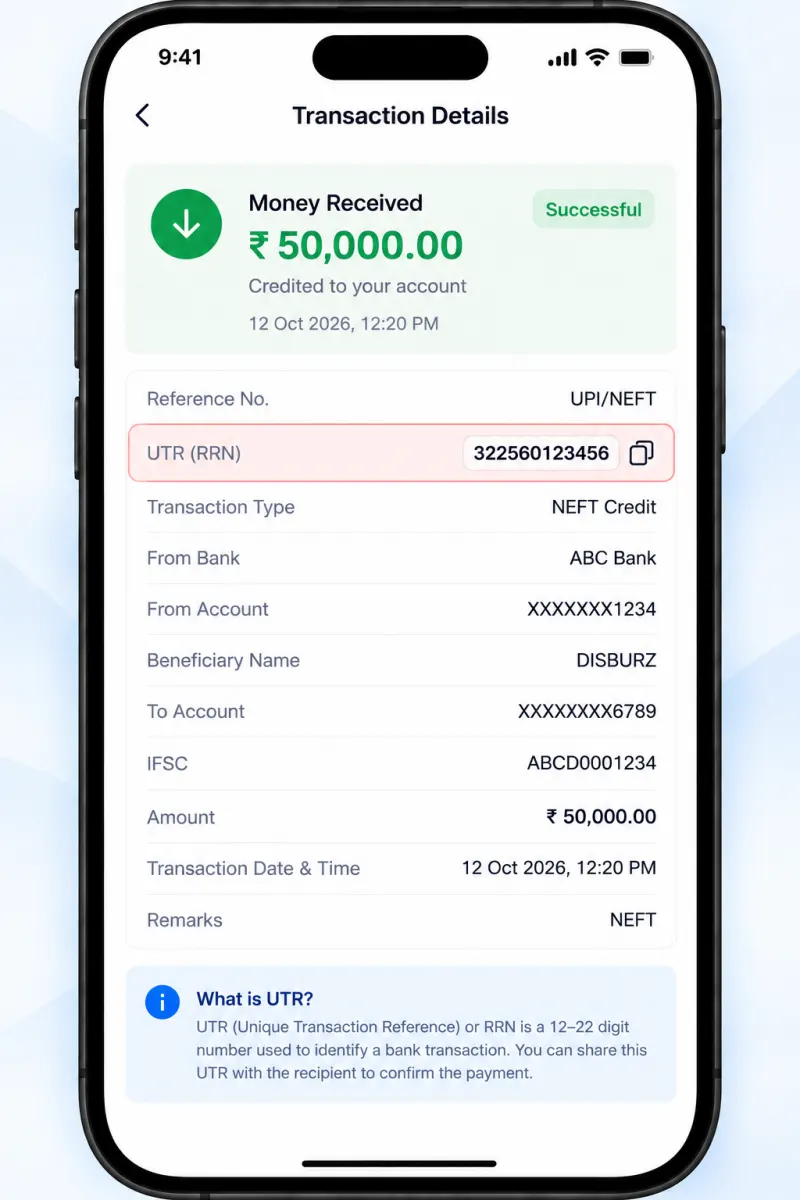
- Open the credit in your bank app or net banking (the incoming amount, not your balance).
- Tap it for details. Look for “UTR”, “Reference no.”, “RRN” or “Transaction ID”.
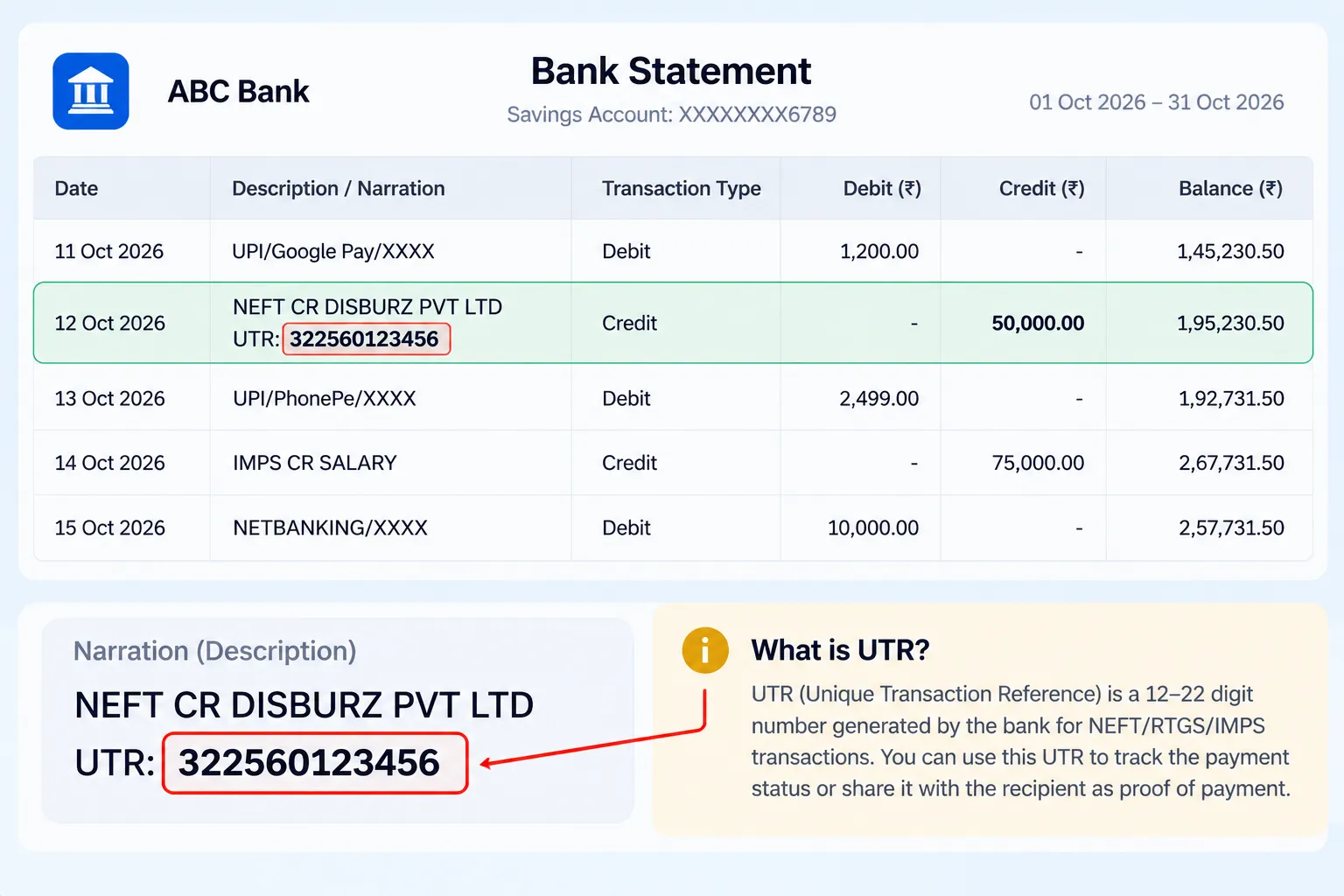
- No details screen? Read the narration line on your statement. It often looks like IMPS/P2A/123456789012/… or NEFT/ABCD…/SENDER NAME, with the reference inside.
- Still can’t see it? Download the statement as PDF, or ask your branch. They can search by the UTR you were given.
UTR vs transaction hash vs order number
Selling crypto gives you three different references. They answer different questions:
| Reference | Proves | Where you check it |
|---|---|---|
| Transaction hash (tx hash) | Your USDT left your wallet and arrived | Tronscan or another block explorer |
| Order number | Which sale it was | Your Disburz Order History |
| UTR | The rupees were sent to your bank | Your bank app or statement |
If something goes wrong, the tx hash and the UTR between them cover the whole journey, from blockchain to bank. We walk through that journey in what happens after you send USDT.
You have a UTR but no money. What now?
Don’t panic. A UTR means the transfer was made, so the money is somewhere it can be found.
- Allow for the method. IMPS usually lands in minutes. NEFT settles in half-hourly batches and can take a few hours. RTGS runs in banking hours.
- Check the right account. If you have more than one, match the last four digits in your payout email.
- Call your bank with the UTR. Ask them to trace the incoming credit. This is the fastest fix, because only your bank can see what happened on its side.
- On Disburz, raise a ticket under Support with the order and the UTR if your bank can’t find it.
Why a UTR matters when you sell crypto
In a P2P trade you might get a UPI reference from a stranger’s account, and that reference can later turn up in a fraud complaint. When a single business pays you, the UTR points to that business’s account and your own sale. It’s a clean record you can show your bank, your CA or the tax department if anyone asks where the money came from. See how to sell USDT without P2P for why that matters.
Related: how long USDT to INR settlement takes · what is a crypto offramp · get a live quote.