
Safety · 5 min read
P2P vs Crypto Offramp: The Safer Way to Cash Out in India
P2P vs direct crypto offramp in India — bank freeze risk, pricing, speed and safety compared, and when each option makes sense.
By Bryan Aaron · Updated
Quick answer
On P2P you sell crypto to a stranger who pays your bank, so if their money came from fraud your account can be frozen. A direct crypto offramp buys your crypto itself and pays INR from its own business account, with a bank UTR as proof. P2P can pay slightly more, but carries counterparty risk.
Peer-to-peer (P2P) trading was, for years, the default way to turn crypto into INR in India. It still works — but it carries risks that many sellers only discover after their bank account is frozen. Here's an honest comparison. New to the term? Read what a crypto offramp is in India first.
How P2P works
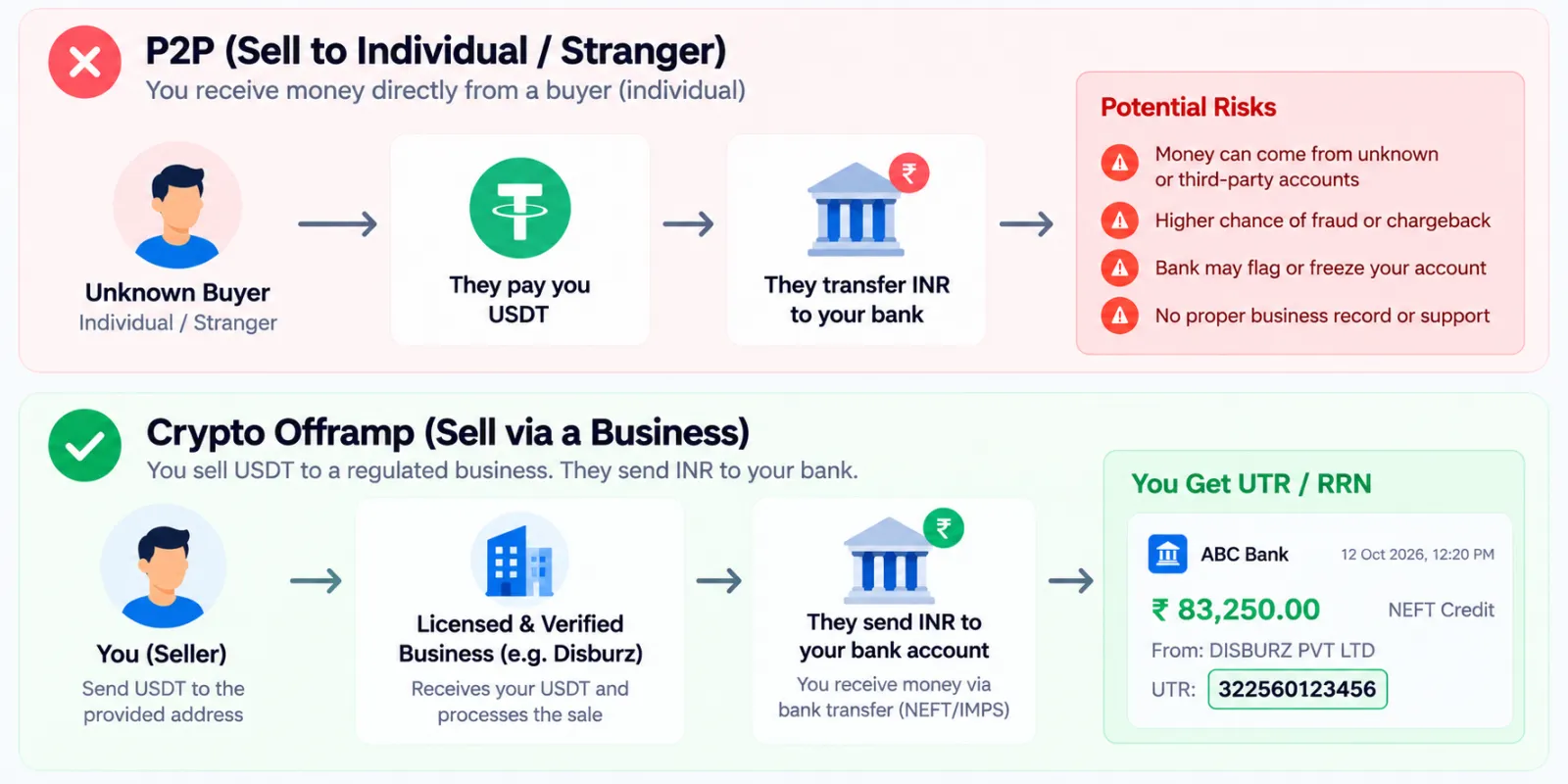
You list USDT on a marketplace. A buyer you don't know sends INR to your bank by UPI or IMPS, you confirm receipt and the platform releases your USDT from escrow.
The risks
- Bank freezes. If the buyer's money is traced to a fraud complaint, police can ask your bank to freeze your account — even though you did nothing wrong. If it's already happened, here's what to do when your account is frozen after P2P.
- Payment disputes. Chargebacks, fake payment screenshots and partial payments.
- Unpredictable price. You negotiate with each buyer, and large amounts get split into many trades.
- Time. Waiting for buyers, confirming each payment manually.
How a direct offramp works
You sell to the offramp itself. You get a quote, send crypto to a deposit address, and the offramp pays INR to your bank from its own business account. Disburz's payout partner pays via IMPS, NEFT or RTGS and you get a UTR for every payout.
Side by side
| P2P | Direct offramp (Disburz) | |
|---|---|---|
| Who pays you | An unknown individual | Disburz |
| Price | Negotiated per trade | Live quote, locked when you confirm |
| Fees | Often hidden in the price | Every fee shown in the quote |
| Bank freeze risk from third-party funds | Significant | Avoided — no third-party payers |
| Proof of payment | Screenshots | Bank UTR |
| Speed | Depends on buyer | Most settle in under 2 minutes |
The bottom line
P2P can occasionally pay a slightly higher rate, but you take on counterparty risk to get it. If what you want is INR in your account without surprises, a direct offramp is the simpler choice. Compare the final number yourself with the USDT to INR calculator.
Worried about the law as well as the risk? Read is it legal to sell USDT in India.