
How-to · 5 min read
What Is a Crypto Offramp? How to Offramp Crypto to INR in India
What a crypto offramp (off-ramp) is and how to offramp crypto to INR in India: types, legality, costs, offramp vs exchange vs P2P, and how to pick one.
By Bryan Aaron · Updated
Quick answer
A crypto offramp (also written off-ramp) is a service that buys your crypto and pays ordinary money into your bank account. In India you send USDT or another coin to an address and receive rupees by IMPS, NEFT or RTGS. Unlike P2P, the money comes from one business, and unlike an exchange there's no balance to withdraw.
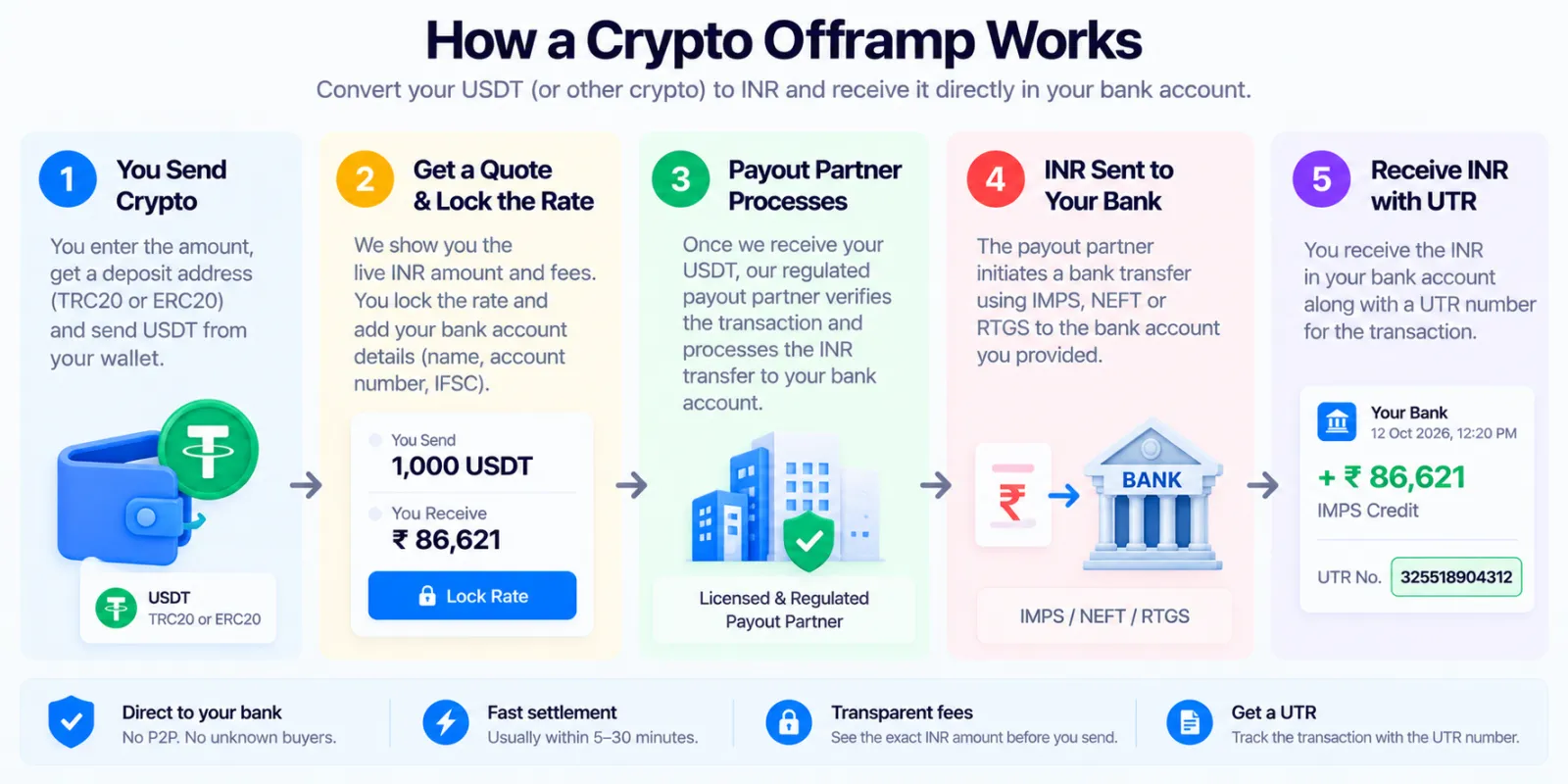
A crypto offramp (also written off-ramp or off ramp) is a service that takes your crypto and pays you ordinary money in your bank account. To “offramp crypto” simply means cashing it out this way. In India that means you send USDT (or another coin) to an address, and the offramp pays rupees to your account by IMPS, NEFT or RTGS. You don’t trade on an order book, keep a balance or wait for a buyer. You get one INR amount upfront, and that’s what arrives.
Disburz is an offramp, and it’s our product. This page explains the idea first and then how ours works.
Offramp vs onramp
The names come from motorways. An onramp gets you into crypto: you pay rupees and get USDT. An offramp gets you out: you send USDT and get rupees. Some services do both. Disburz only does the second.
How an offramp works, step by step
- Quote. You enter how much crypto you’re selling and your bank details, and see the rate, the fees and the final INR.
- Lock. You confirm, and that rate is held while you send.
- Send. You transfer the crypto to the deposit address on the network shown.
- Confirm. The blockchain confirms the transfer. On Tron (TRC20) that’s about 19 blocks, roughly a minute.
- Payout. The rupees go to your bank, and you get a UTR number as proof.
Every step is shown on screen as it happens. For the detail, read what happens after you send USDT.
Types of crypto offramp in India
“Offramp” covers a few different things. Which one you need depends on who you are:
| Type | Who it's for | How you get INR |
|---|---|---|
| Direct offramp | Individuals with crypto in a wallet or on a global exchange | Send crypto, receive INR by IMPS, NEFT or RTGS |
| Indian exchange | People whose crypto is already on that exchange | Sell on the order book, then withdraw INR |
| Offramp API or widget | Apps, wallets and businesses adding a “sell” button | Through the app that embeds it |
| Crypto debit card | Spending abroad or online | Card payments, not INR in your bank |
| P2P marketplace | Not an offramp: you sell to a stranger | The buyer sends UPI or a bank transfer |
Is it legal to offramp crypto in India?
Yes. Selling crypto for rupees is legal. It's taxed as a virtual digital asset: a flat 30% on gains plus cess, with 1% TDS where it applies. Crypto service providers that serve Indian users are expected to register with FIU-IND as reporting entities under anti-money-laundering rules. Before you use any offramp, ask who actually pays you and check that the rupees come from a business account with a UTR. More in is it legal to sell USDT in India.
Offramp vs exchange vs P2P
| Offramp | Exchange | P2P | |
|---|---|---|---|
| Who pays you | The offramp or its payout partner | The exchange, when you withdraw | A stranger |
| Steps | Quote → send → INR in bank | Deposit → sell → withdraw | Find buyer → wait for UPI → release |
| Final INR known upfront | Yes | Only after you add up the fees | Agreed per trade |
| Bank freeze risk from tainted funds | Low | Low | Real |
| Best for | Crypto in a wallet, one-off or regular sales | Crypto already on that exchange | Not recommended |
If your USDT already sits on an Indian exchange where you’ve done KYC, selling there is fine. An offramp earns its place when your crypto is in a wallet like Trust Wallet or on a global exchange such as Binance, because it skips the deposit-sell-withdraw loop. We compare every route in the best way to sell USDT in India.
What an offramp costs
There’s always a rate and usually one or two fees. The only fair comparison is the INR that reaches your bank for the same amount of crypto at the same time.
Worked example on Disburz (October 2026): you sell 1,000 USDT at ₹96. Trans Ramp, our payout partner, deducts 3 USDT, so 997 USDT is converted: 997 × 96 = ₹95,712. Minus the ₹50 fee, ₹95,662 reaches your bank. Today’s numbers are on the USDT to INR page. More on where costs hide in crypto to INR fees explained.
How to check an offramp before you use it
- Who sends the rupees? A named business, never “a buyer”.
- Do you see the final INR before sending? Not just a rate.
- Which networks does it accept? Sending on the wrong one can lose the funds.
- Do you get a UTR for every payout? It’s your proof.
- Can you reach a person? A ticket system or a real support channel.
How Disburz works as an offramp
You get a quote on Disburz, confirm it, and Trans Ramp’s payment page opens with a deposit address. You send USDT on TRC20 (Tron) within 30 minutes, the page counts confirmations to 19/19, and Trans Ramp pays INR to your bank by IMPS, NEFT or RTGS. You get one email when your USDT arrives and another with the UTR when the rupees are sent. We don’t ask you to upload ID documents; Trans Ramp runs its own checks and may contact you if it needs more information.
Crypto sales are taxed in India whichever route you use. Read our crypto tax and TDS guide and check with a CA.
Next: how to sell USDT for INR, step by step, or get a live quote.
Common reasons people use one: freelancers paid in USDT, USDT sent by family abroad and selling a large amount of USDT.