
Safety · 6 min read
Is It Legal to Sell USDT in India? The Law, Tax and Risks (2026)
Yes, selling USDT is legal in India. What the law actually says, how the 30% tax and 1% TDS apply to stablecoins, and what gets sellers into trouble.
By Bryan Aaron · Updated
Quick answer
Yes. No Indian law bans owning, buying or selling USDT. It isn't legal tender, but selling it for INR is a lawful sale of a virtual digital asset: the gain is taxed at 30% plus cess, 1% TDS can apply, and platforms fall under anti-money-laundering rules. Trouble comes from who pays you, not from selling.
“Is this even allowed?” is the first thing most people ask before they sell USDT for the first time. The short answer is yes. The longer answer is that the law is rarely what gets sellers into trouble. Who pays them, and whether they report the gain, is.
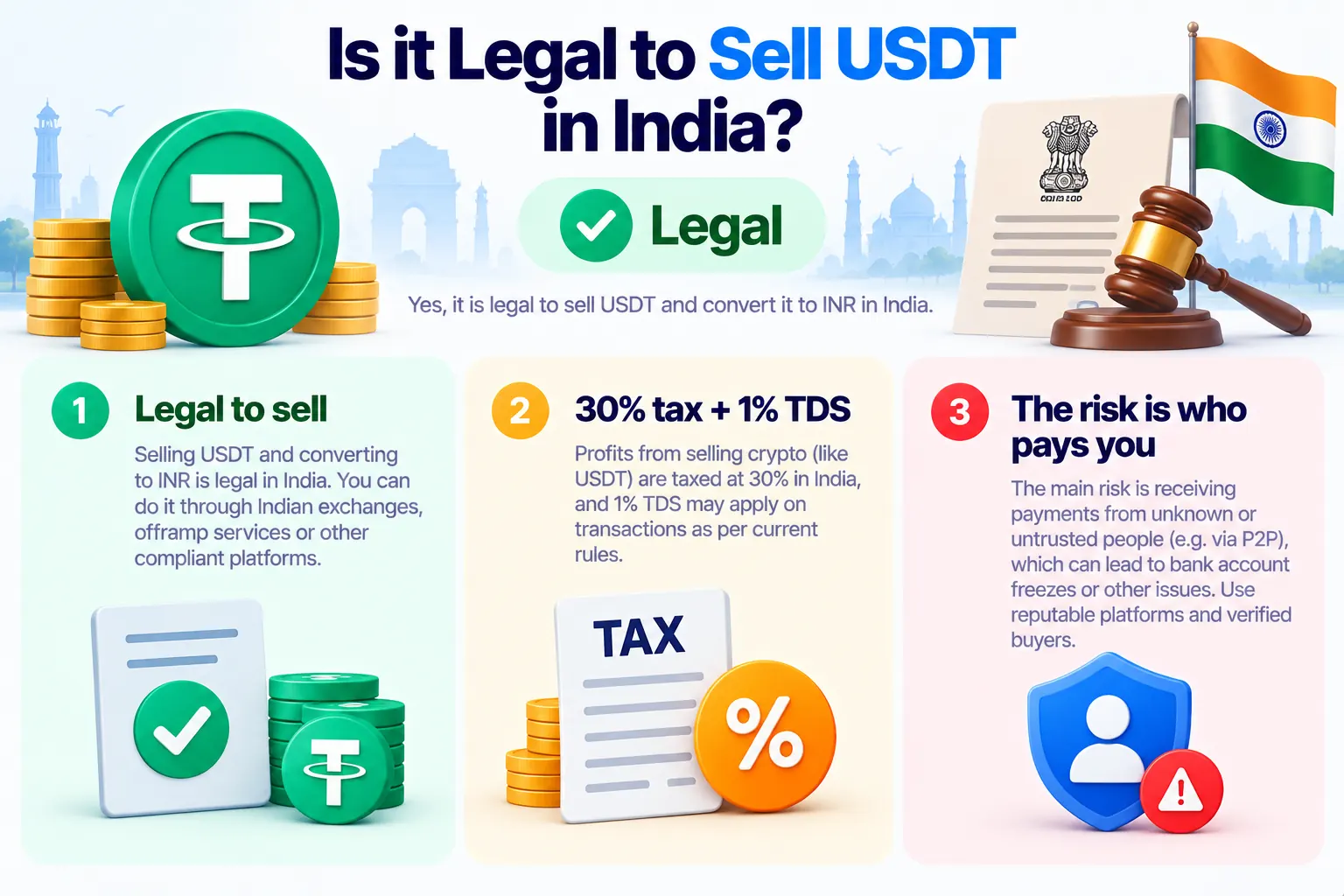
Is USDT legal in India?
Yes. Owning, buying and selling USDT is legal. USDT isn't legal tender, so no shop has to accept it, but nothing in Indian law stops you from selling your own USDT for rupees. India hasn't passed a full crypto law. Instead, two sets of rules apply:
- Tax law. Crypto, stablecoins included, is a virtual digital asset (VDA). Gains are taxed at a flat 30% plus cess, and 1% TDS can apply on sales above yearly thresholds.
- Anti-money-laundering law. Since March 2023, businesses that exchange, transfer or hold VDAs for others are covered by the Prevention of Money Laundering Act and must register with FIU-IND, keep records and report suspicious transactions.
Why people think crypto is banned
The confusion has a history:
- 2018: the RBI told banks to stop serving crypto businesses. For many people this felt like a ban.
- March 2020: the Supreme Court struck that circular down, and banks could serve crypto businesses again.
- 2022: the Finance Act brought in the 30% tax on VDA gains and the 1% TDS on transfers. Taxing crypto is the opposite of banning it.
- 2023 onwards: anti-money-laundering rules were extended to crypto platforms, and offshore exchanges that hadn't registered with FIU-IND were sent notices and blocked.
Headlines about a possible crypto bill still appear, but no ban has been passed. Until a new law says otherwise, selling USDT is a lawful, taxable sale.
USDT is a stablecoin. Is it still taxed?
Yes. This is a common mistake: people assume that because USDT tracks the dollar, there's no gain to tax. But tax is worked out in rupees: if the rupee price of USDT went up between your purchase and your sale, you made a gain.
Example: you bought 1,000 USDT at ₹90 (₹90,000) and sell at ₹96 (₹96,000). The gain is ₹6,000. Tax at 30% plus 4% cess is about ₹1,872. Under the VDA rules only the purchase cost is deducted, not platform fees, and a loss on one sale can't be set off against another.
If you received USDT as payment for work, the picture is different: it's usually income first. See getting paid in USDT as a freelancer and our crypto tax and TDS guide.
What actually gets USDT sellers into trouble
The sale is legal. These are not:
- Taking money from a stranger that turns out to be stolen. On P2P, a scammer can pay you with a victim's money. The victim complains, and police freeze your account even though you did nothing wrong. See what to do if your account is frozen.
- Accepting payment from third parties, meaning anyone other than the buyer, in their own name.
- Selling for other people or lending your bank account (“account renting”). Your account then carries their money and their risk.
- Splitting sales to stay under limits or using many bank accounts to avoid attention. Banks are trained to spot exactly this pattern.
- Not reporting gains. Crypto sales show up in tax records, and notices follow unreported activity.
How to sell USDT legally and safely
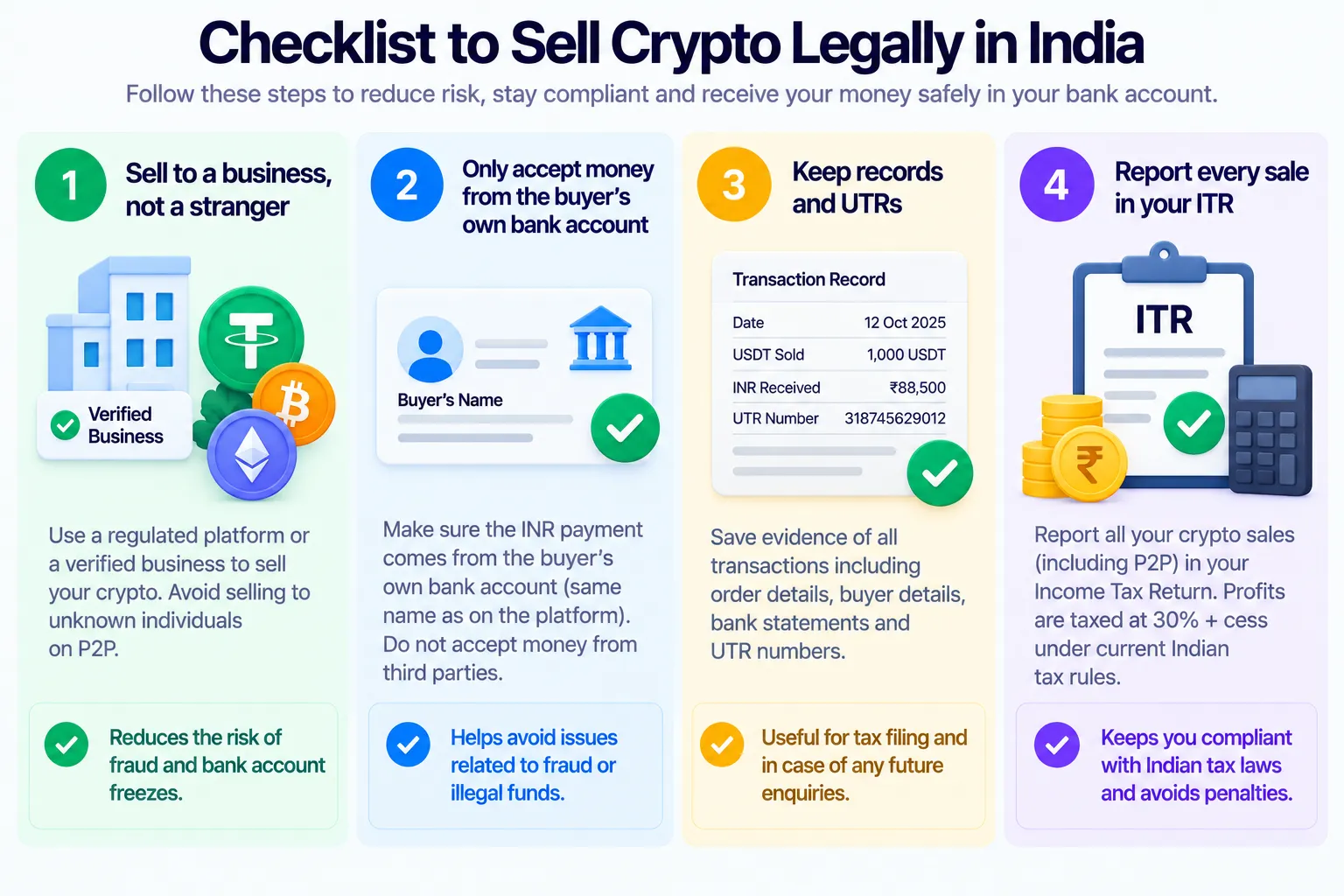
- Sell to a business, not a stranger. A direct offramp or an Indian exchange pays you from its own bank account, so the rupees can't be a fraud victim's.
- Use a bank account in your own name. Never ask for, or accept, payouts to someone else's account.
- Keep the proof. Save every sale's order details and the bank reference (UTR). It answers your bank's questions and backs up your tax return.
- Report every sale in the VDA schedule of your income tax return, with what you paid for the USDT.
How selling on Disburz works, legally
On Disburz you deal with one business, not a stranger. Disburz gives you the quote and handles your account and support. Our payout partner Trans Ramp receives your USDT on its payment page, runs its own checks and pays INR to your bank by IMPS, NEFT or RTGS. You get the UTR by email.
- Payouts go only to a bank account in your own name.
- Disburz doesn't ask you to upload documents or a PAN. Trans Ramp may contact you if its checks need more information.
- Reporting the sale and paying any tax on the gain is your responsibility, as with any platform.
Worked example (live)
| Arrives at Disburz | 1,000 USDT (TRC20) |
| Network deduction | − 3 USDT |
| Rate | 1 USDT = ₹96.00 |
| Converted value | ₹95,712.00 |
| Fee | − ₹50.00 |
| Paid to your bank | ₹95,662.00 |
|---|
These numbers come from today's live quote and update with it. Ready to sell? Follow how to sell USDT for INR, or read is P2P crypto trading legal in India if you're weighing P2P.
The bottom line
Selling USDT in India is legal. Sell to a business that pays you from its own account, keep the UTR and declare the gain, and you're on the right side of the rules India has today.