
Safety · 9 min read
Bank Account Frozen After a P2P Crypto Trade? What to Do Next
Your bank froze your account after you sold USDT on P2P. Here's why it happens, the 7 steps to get it released and what not to do while you wait.
By Bryan Aaron · Updated · यह गाइड हिंदी में पढ़ें
Quick answer
Banks usually freeze an account after a P2P crypto sale because the buyer's money was linked to a fraud complaint and the police asked for it to be held. Find out which police station or cyber cell ordered it, send them your trade records, and ask for the freeze to be limited to the disputed amount. Never pay 'unfreeze agents'.
If your bank froze your account after you sold USDT on P2P, the most likely reason is that the money your buyer sent was traced to a fraud complaint. The freeze isn’t an accusation that you’re a criminal. It’s the police preserving a money trail. Accounts do get released, usually faster when you act early, stay organised and deal only with the officials actually handling the case.
Here’s what’s happening, and what to do in order.
Why this happens (even when you did nothing wrong)
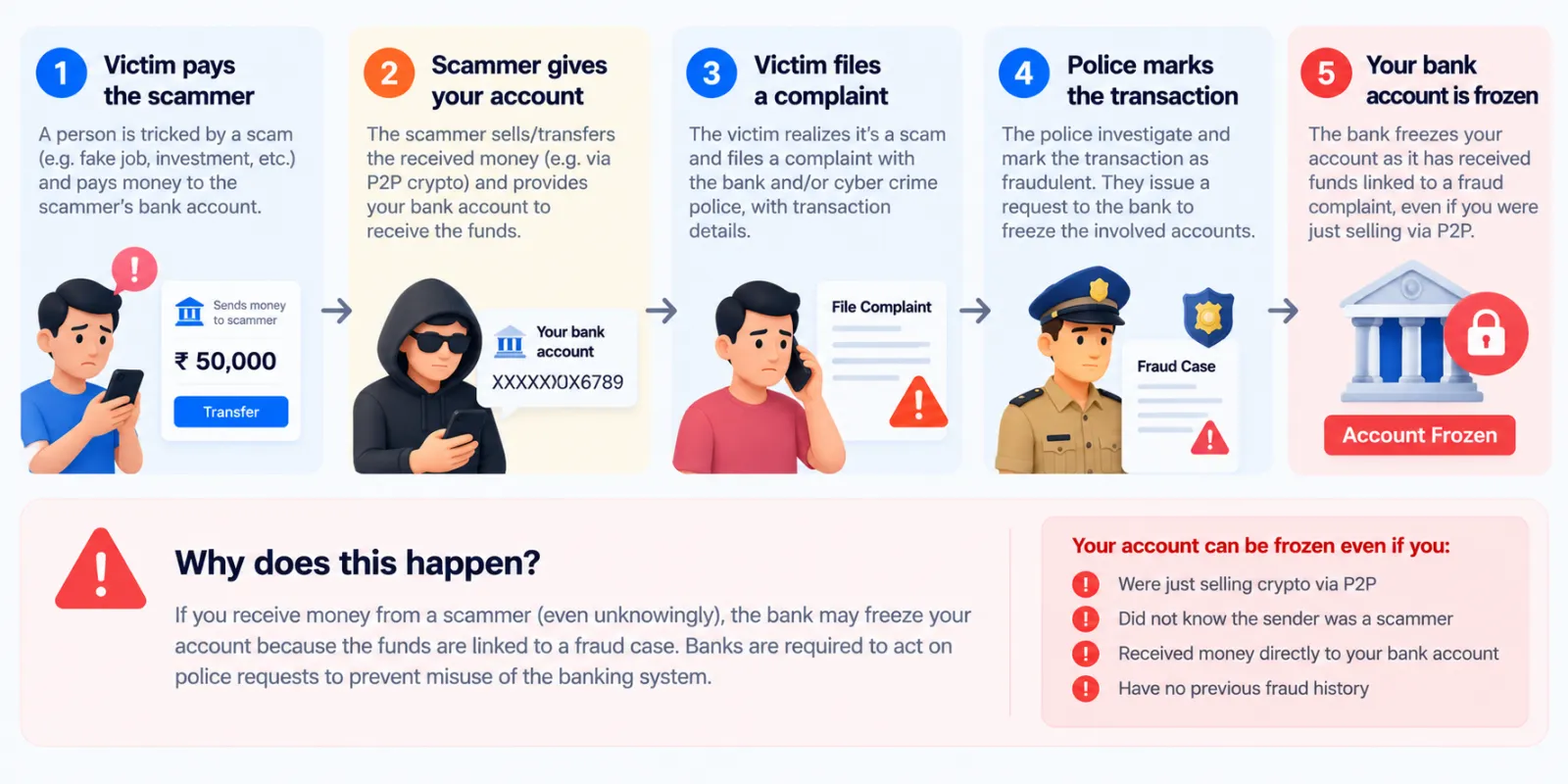
The pattern is nearly always the same:
- A scammer tricks someone into “paying” for a fake job, investment or parcel.
- Instead of their own account, the scammer gives the victim your bank details, copied from your P2P sell order.
- You see money arrive, think the buyer paid, and release the USDT. The scammer walks away with it.
- The victim realises they’ve been cheated and files a complaint on the national cyber-crime portal. Police trace the money to your account and tell your bank to block it.
You were the last stop in someone else’s fraud. That’s why it feels so unfair, and also why the facts usually work in your favour once they’re on paper.
Lien, debit freeze or full freeze: know which one you have
- Lien on an amount: only a specific sum (often the disputed payment) is blocked. You can use the rest.
- Debit freeze: money can come in, but nothing can go out.
- Total freeze: the whole account is blocked.
This matters, because courts have said a freeze should be proportionate to the disputed amount. If ₹18,000 came from a complaint and your whole ₹4 lakh balance is blocked, that is something a lawyer can challenge.
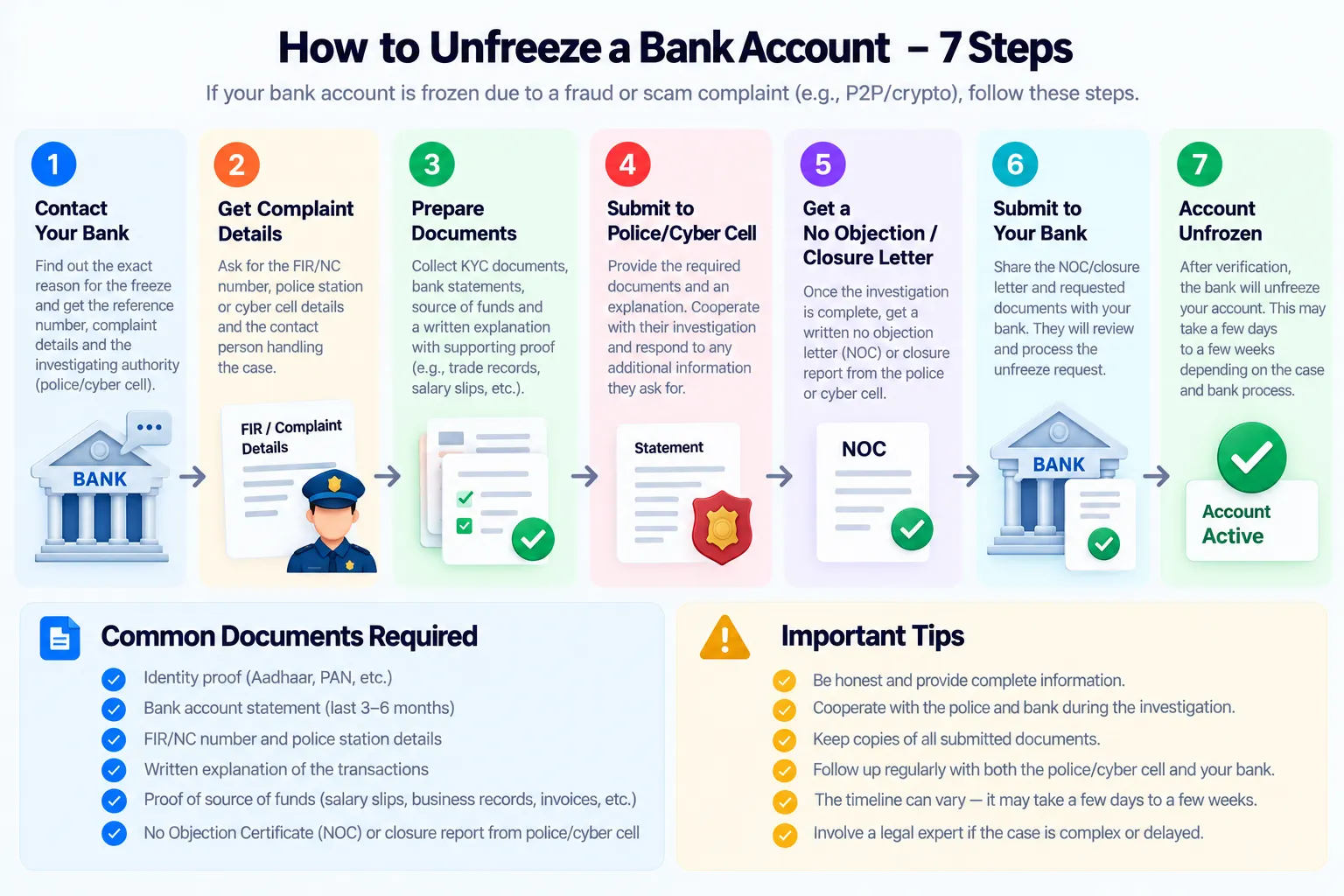
Step 1: Stop, and don’t make it worse
- Pause all P2P trading, on every account you have.
- Don’t delete chats, screenshots, the P2P app or your trade history.
- Don’t send money to anyone who calls claiming to be the police, the victim or a “settlement officer”. Real officials won’t ask you to pay a private UPI ID.
Step 2: Get the details from your bank, in writing
Visit your home branch and ask for a written note or email showing:
- which police station or cyber cell asked for the freeze, and the officer’s name if available;
- the complaint, acknowledgement or FIR number;
- the date of the request;
- whether it’s a lien on a specific amount, a debit freeze or a total freeze, and how much.
Your bank can’t lift a police freeze on its own, so arguing with the branch won’t help. What they can give you is the information you need for every next step.
Step 3: Put together your evidence pack
Collect everything that shows this was a genuine trade:
- the P2P order ID, date, amount, price and status from the platform;
- the buyer’s name and profile as shown on the platform;
- your full chat with the buyer;
- your bank statement showing the incoming credit, with its UTR;
- the blockchain transaction hash showing the USDT you released;
- your KYC on the platform and your PAN;
- if you file taxes on crypto, your ITR or records showing you report these trades.
Put it in one PDF, in date order, with a one-page summary on top. Officers are busy, and a clean file gets read.
Step 4: Ask the P2P platform for a trade statement
Raise a support ticket with the platform, quoting the order ID and the complaint number. Ask for a statement confirming the trade, the buyer’s verified identity on the platform and the release of your crypto. Large platforms have law-enforcement teams used to these requests.
Step 5: Write to the investigating officer
Email the cyber cell or police station named by your bank, and if possible visit in person. Keep it short and factual: who you are, the trade, why the money came to you, and what you’re asking for. That means releasing the account, or at least limiting the block to the disputed amount. Attach the evidence pack. Keep proof that you sent it.
Be ready for one uncomfortable possibility. If the money you received really was stolen, you may be asked to let that specific amount go back to the victim. Your claim is then against the buyer who cheated you both, through the platform and the police. It isn’t fair, but it’s often the fastest way to get the rest of your account back.
Step 6: If nothing moves, go to court
If you hear nothing for a few weeks, or your whole balance is blocked over a small amount, speak to a lawyer. Under the Bharatiya Nagarik Suraksha Sanhita (BNSS), police can seize property as evidence (section 106, which replaced section 102 of the old CrPC), but they must report it to a Magistrate. Courts, including a Delhi court in March 2026, have said that attaching a bank account needs a Magistrate’s order under section 107. Applications before the Magistrate, and in some cases a writ petition before the High Court, have got accounts released or limited to the disputed sum.
Step 7: Keep a log
Note every call, visit and email: date, who you spoke to, what they said. If this goes to court, that log is evidence that you cooperated from day one.
What not to do
- Don’t pay “unfreeze agents”. People who promise to get your account released for a fee, or claim to know someone in the cyber cell, are a well-known follow-on scam.
- Don’t open a new account to keep trading P2P. The same thing can happen again, and a second freeze looks far worse.
- Don’t ignore notices. If police ask you to appear or reply, do it, with your evidence.
How to stop it happening again
The risk comes from one thing: rupees arriving from a stranger’s bank account. Remove the stranger and you remove most of the risk. When you sell to an Indian exchange or a direct offramp, the money comes from that company’s own business account.
With Disburz, you send USDT and get paid by our payout partner Trans Ramp from its own business account, with a bank UTR for every payout, so there are no third-party funds in your account. See how every route compares in our guide to the best way to sell USDT in India, or check today’s USDT to INR rate.
For the legal background, see is P2P crypto trading legal in India, and for the patterns banks watch, how much USDT you can sell without bank problems.
Other tricks to watch for are in USDT scams in India, and the safer routes in Binance P2P alternatives.