
Safety · 6 min read
How Much USDT Can You Sell in India Without Bank Problems?
There's no legal limit on selling USDT in India. The limits that do exist, what makes banks flag an account, how a lien happens and how often you can sell safely.
By Bryan Aaron · Updated
Quick answer
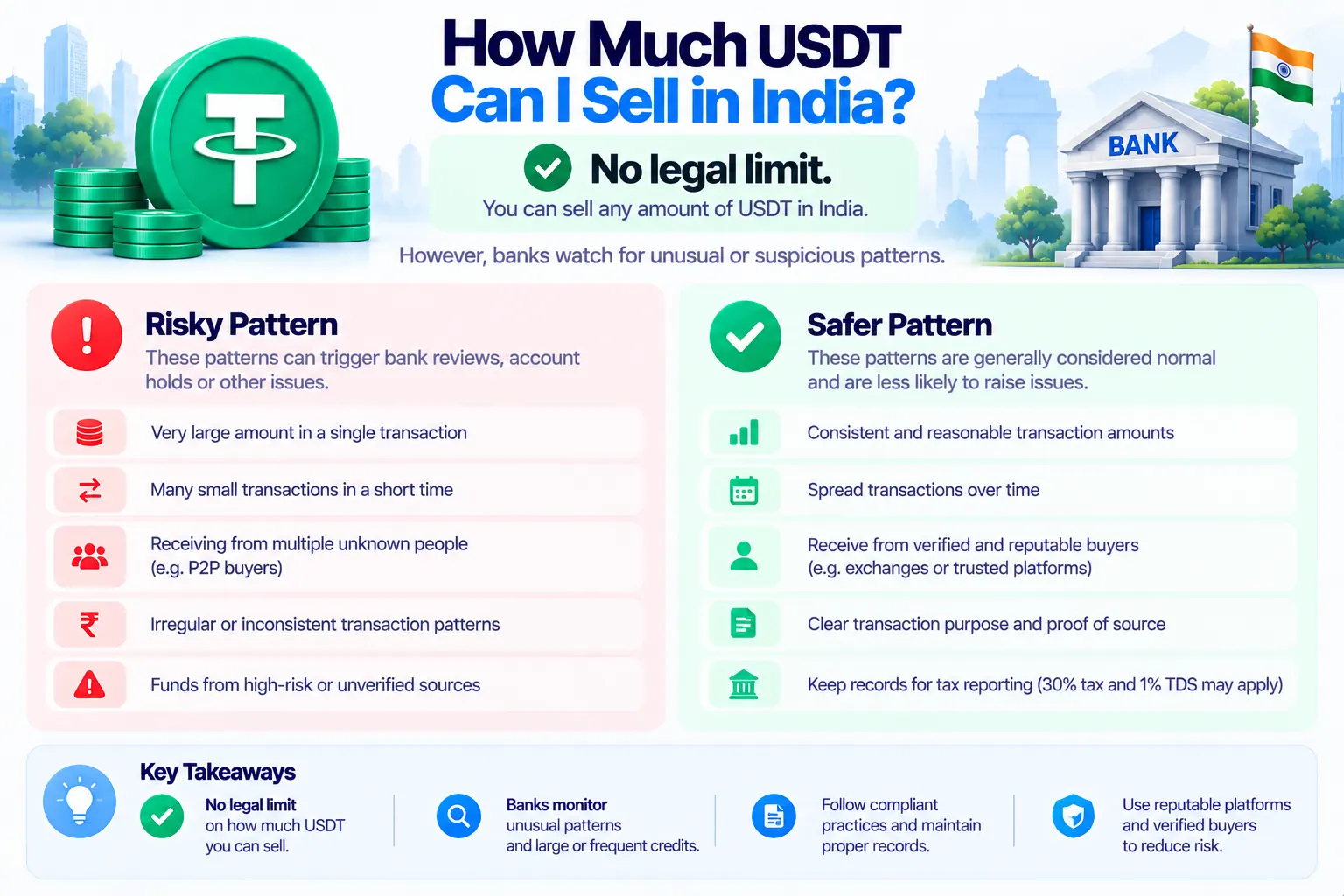
There's no legal limit on how much or how often you can sell USDT in India. The limits that matter are your platform's order size, your bank's transfer limits and tax thresholds. Banks flag patterns, not amounts: many credits from strangers, money passed straight on, or volumes that don't match your profile.
“How much can I sell before my bank has a problem?” and “Can I sell every week?” are really the same worry: nobody wants a frozen account. The good news is that banks don't care about a magic number. They care about patterns. Get the pattern right and the amount stops mattering.
Is there a legal limit on selling USDT?
No. No Indian law caps how much USDT you can sell or how often. Selling is a lawful, taxable sale, as explained in is it legal to sell USDT in India. The limits you'll actually meet are practical ones.
The limits that do exist
- Platform limits. Every platform has a minimum and a maximum per order. On Disburz today the minimum is 13.95 USDT and the maximum is 1,00,000 USDT per order.
- Transfer limits. IMPS is usually up to ₹5 lakh per transfer, RTGS starts at ₹2 lakh, and NEFT has no RBI cap. Your bank may set its own limits on incoming or daily amounts. See IMPS vs NEFT vs RTGS vs UPI.
- Tax thresholds. 1% TDS can apply once your sales pass ₹50,000 a year for most individuals (₹10,000 for others). It's a tax rule, not a cap: you can keep selling. See crypto tax and TDS in India.
What makes a bank flag your account
Banks run automated monitoring for money-mule and fraud patterns. Crypto isn't the trigger. These patterns are:
- Many credits from different strangers. Ten UPI payments a day from ten unknown people is exactly what P2P selling looks like, and exactly what mule accounts look like.
- Money in, money straight out. Rupees that arrive and leave within minutes look like a pass-through account.
- Volumes that don't match your profile. ₹20 lakh a month through a student savings account will get noticed, whatever its source.
- Splitting to stay under limits. Many payments just under a round figure look deliberate. Splitting to avoid attention attracts it.
- Someone else using your account. Selling for friends or “renting” your account means their money, and their risk, runs through your name.
Lien vs freeze: where the real danger comes from
Most frozen accounts after crypto sales aren't the bank's own decision. They start with a scam victim filing a cybercrime complaint. Police trace the victim's money to whoever received it, and the bank puts a lien on that amount or freezes the account. If a P2P buyer paid you with stolen money, that someone is you.
That's why the amount you sell matters far less than who pays you. A single ₹5,000 P2P trade with a scammer can block your account. A ₹5 lakh payout from a business's own account won't trigger a cybercrime lien, because no victim's money is involved. If it has already happened, follow what to do when your account is frozen.
How often can you sell?
As often as you like. Frequency on its own isn't a red flag. A freelancer selling client USDT every week, or a trader cashing out monthly, is normal. What matters is that the credits look the same each time: one business payer, your own account, a UTR for each payout and amounts that fit your income.
Repeated payouts from one business are easy to explain. Repeated payments from dozens of different strangers are not.
How to sell any amount without bank problems
- Get paid by a business, not people. A direct offramp or an Indian exchange pays from its own account.
- Use one bank account in your own name, and leave the money there for normal use rather than moving it straight on.
- Keep a proof file: order details, the UTR for every payout and where the USDT came from (exchange statement, client invoice).
- Split only for practical reasons. A small test order first is sensible. Splitting to stay under limits isn't.
- Answer your bank honestly if it asks. A clear explanation with records ends most questions.
- Report every sale in your income tax return, so your bank credits and your tax records match.
Selling on Disburz
On Disburz there are no strangers in the chain. Our payout partner Trans Ramp receives your USDT and pays INR from its own business account to a bank account in your name, by IMPS, NEFT or RTGS, with the UTR emailed to you. Selling a large sum? Read how to sell a large amount of USDT.
Worked example (live)
| Arrives at Disburz | 1,000 USDT (TRC20) |
| Network deduction | − 3 USDT |
| Rate | 1 USDT = ₹96.00 |
| Converted value | ₹95,712.00 |
| Fee | − ₹50.00 |
| Paid to your bank | ₹95,662.00 |
|---|
These numbers come from today's live quote and update with it.