
How-to · 8 min read
Best Way to Sell USDT in India (2026): 4 Routes Compared
P2P, Indian exchanges, global exchanges or a direct offramp? We compare the 4 ways to sell USDT in India on cost, speed, bank-freeze risk and effort.
By Bryan Aaron · Updated
Quick answer
For most people in India, the safest way to sell USDT is a route where a registered business pays you from its own bank account: an Indian exchange if your USDT is already there, or a direct offramp if it's in a wallet or on Binance. P2P can pay slightly more, but risks a bank freeze.
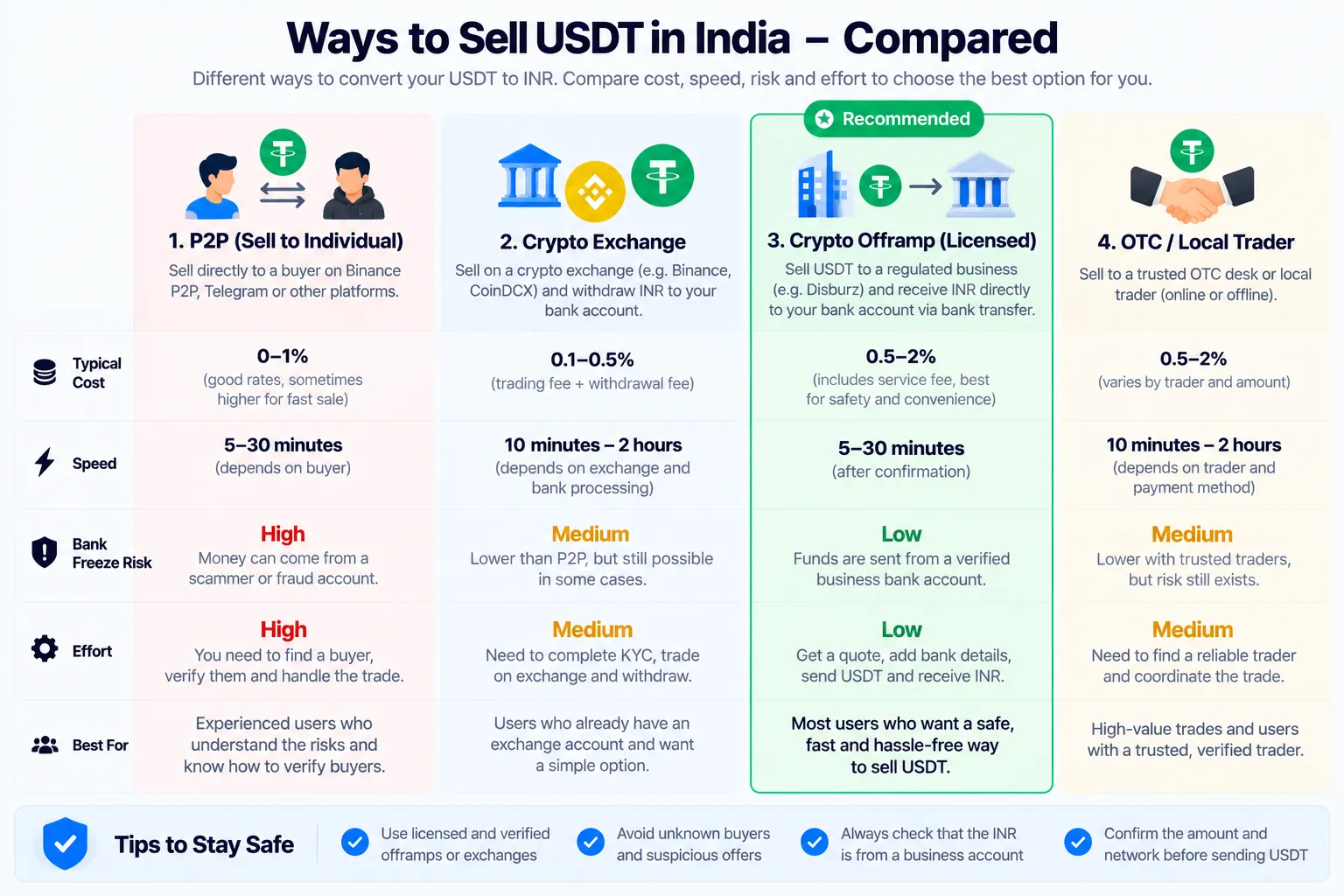
There are four real ways to turn USDT into rupees in India: P2P, an Indian exchange, a direct offramp, or an OTC desk for large amounts. No single one is best for everyone. For most people selling a few hundred to a few thousand USDT, the safest choice is a route where a registered business pays you from its own bank account, not a stranger. That one detail decides whether your bank account stays safe.
Quick disclosure: Disburz is one of the options below, and it’s our product. We’ve tried to be fair, and we tell you where the other routes beat us.
The short version
- Selling once, small amount, already on an Indian exchange? Sell there and withdraw INR. It’s fine.
- USDT sitting in Binance, Trust Wallet or MetaMask? A direct offramp saves you a step and pays straight to your bank. Step by step: from Binance or from Trust Wallet.
- Chasing the highest possible rate and okay with risk? P2P sometimes pays a little more. Read about bank freezes first.
- Selling ₹25 lakh or more? Talk to an OTC desk and get RTGS settlement.
The 4 routes side by side
| P2P | Indian exchange | Direct offramp | OTC desk | |
|---|---|---|---|---|
| Who pays you | An unknown buyer | The exchange | The offramp | The desk |
| Where the cost hides | In the negotiated price | Spread + trading fee + INR withdrawal fee | Stated fees shown in the quote | Negotiated spread |
| Bank-freeze risk from third-party money | Real | Low | Low | Low |
| Steps to reach your bank | Find buyer → check payment → release | Deposit → sell → withdraw INR | Quote → send → paid | Call → agree rate → send → paid |
| Typical time | Depends on the buyer | Minutes to a day+ (limits, reviews) | Minutes after confirmation | Same day |
| Best for | Experienced traders who accept the risk | People already using that exchange | USDT in any wallet, regular sellers | Large one-off amounts |
How we compared: who actually sends you the rupees, every cost between your USDT and your bank balance, the number of steps, typical time, and the risk of third-party funds reaching your account. Checked October 2026.
Route 1: P2P (peer-to-peer)
You list USDT on a marketplace such as Binance P2P. A buyer sends rupees by UPI or IMPS, you confirm the money arrived, and the platform releases your USDT from escrow.
It’s popular for a reason. There are plenty of buyers, and the price can sit slightly above what exchanges pay. The catch is the money itself. If your buyer paid with funds taken from a fraud victim, the victim’s complaint can lead the police to your account, and your bank will freeze it. Reddit’s r/CryptoIndia is full of these stories, including from verified merchants who did everything “right”.
If you still use P2P, trade only with long-history buyers, never accept money from a name that doesn’t match the buyer’s profile, and keep every screenshot. Here’s a fuller look at P2P vs a direct crypto offramp.
Route 2: Sell on an Indian exchange, then withdraw INR
Deposit USDT to an FIU-registered Indian exchange, sell it on the USDT/INR market, then withdraw the rupees to your bank. The exchange pays you, so the third-party money problem mostly goes away.
What to watch for:
- Spread. The price you can actually sell at is lower than the “last price” on the screen. On bigger orders, you eat further into the order book.
- Two fees, not one. A trading fee when you sell, and on some platforms a flat INR withdrawal fee.
- Limits and holds. New accounts often have daily INR withdrawal limits, and large withdrawals can be held for review.
If you already have a verified account and your USDT is there, this is a perfectly reasonable route. Don’t move your USDT elsewhere just to save a few rupees.
Route 3: A direct offramp
An offramp does one thing. It buys your crypto and pays you INR. You get a quote, send USDT from any wallet or exchange to a deposit address, and rupees arrive in your bank account. There’s no INR balance to withdraw and no order book to sell into.
On Disburz, specifically:
- No documents to upload: sign up with your name, email and phone.
- The rate is locked when you confirm. Fees today: ₹50 fee + 3 USDT network deduction, shown before you send. No INR withdrawal fee.
- USDT on TRC20 (Tron) today; more networks are being added.
- Payout by IMPS (24/7), or NEFT/RTGS for larger amounts, with a bank UTR for every payout.
Where an offramp makes most sense: your USDT lives on Binance, in Trust Wallet or MetaMask, or you get paid in stablecoins every month. Where it makes less sense: you’re already on an Indian exchange with an INR balance, and the exchange is quoting you a better final number that day. It happens. Compare.
Route 4: An OTC desk
For large amounts, think ₹25 lakh and up, order books get thin and P2P means splitting into dozens of trades. An OTC (over-the-counter) desk agrees one rate for the whole amount and settles by RTGS. Expect KYC on both sides and a phone call before the trade. Disburz runs a desk for amounts above our 1,00,000 USDT per-order limit. Contact the desk.
Selling 20,000 USDT or more? Read how to sell a large amount of USDT safely.
How to find which route pays you the most
Ignore headline rates. Every platform advertises a number before something comes off it. Compare the rupees that actually land in your bank for the same amount of USDT, on the same network, within a few minutes of each other.
| Arrives at Disburz | 1,000 USDT (TRC20) |
| Network deduction | − 3 USDT |
| Rate | 1 USDT = ₹96.00 |
| Converted value | ₹95,712.00 |
| Fee | − ₹50.00 |
| Paid to your bank | ₹95,662.00 |
|---|
That's today's live Disburz quote for 1,000 USDT. Compare it with what other routes show you for the same 1,000 USDT, or try other amounts in the USDT to INR calculator.
Don’t forget the cost of getting there. Moving USDT from one exchange to another costs a network fee, usually about 1 USDT on TRC20 and more on ERC20. Read every crypto-to-INR fee explained for the full list.
Choosing between specific platforms? See Disburz vs Mudrex vs CoinDCX and the monthly USDT to INR fees table.
Red flags, whichever route you choose
- A “buyer” or “agent” on Telegram or WhatsApp offering a rate well above the market.
- Anyone asking you to send USDT first and promising rupees later, outside a platform.
- Payments from a bank account whose name doesn’t match the person you’re trading with.
- A platform that won’t say plainly what it charges. If you can’t see the final rupee amount before you send, walk away.
Don’t forget tax
Whichever route you pick, India taxes gains on crypto at a flat 30% plus cess, and 1% TDS can apply on the sale. Keep your buy and sell records. Our crypto tax and TDS guide covers how to report it.