
Networks · 7 min read
TRC20 vs ERC20 USDT: Which Network Should You Use?
TRC20 vs ERC20 USDT for Indian users: fees, speed and address formats compared, how to tell which network your USDT is on, and which to use to sell for INR.
By Bryan Aaron · Updated
Quick answer
For selling USDT in India, TRC20 (Tron) is usually the better choice: a transfer costs around a dollar and confirms in about a minute, while ERC20 (Ethereum) fees are higher and swing with gas prices. Both are the same USDT. What matters most is sending on the network the receiver asks for.
USDT exists on several blockchains. The token is the same — one USDT is worth one USDT whichever chain it's on — but the network you move it on decides how much you pay in fees, how fast it arrives and which addresses can receive it. The two most common are TRC20 (Tron) and ERC20 (Ethereum).
Quick comparison
| TRC20 (Tron) | ERC20 (Ethereum) | |
|---|---|---|
| Address format | Starts with T | Starts with 0x |
| Typical network fee | Low — usually around a dollar or less | Higher and variable with Ethereum gas prices |
| Typical confirmation | About 1 minute | A few minutes |
| Best for | Frequent, everyday transfers | DeFi users and funds already on Ethereum |
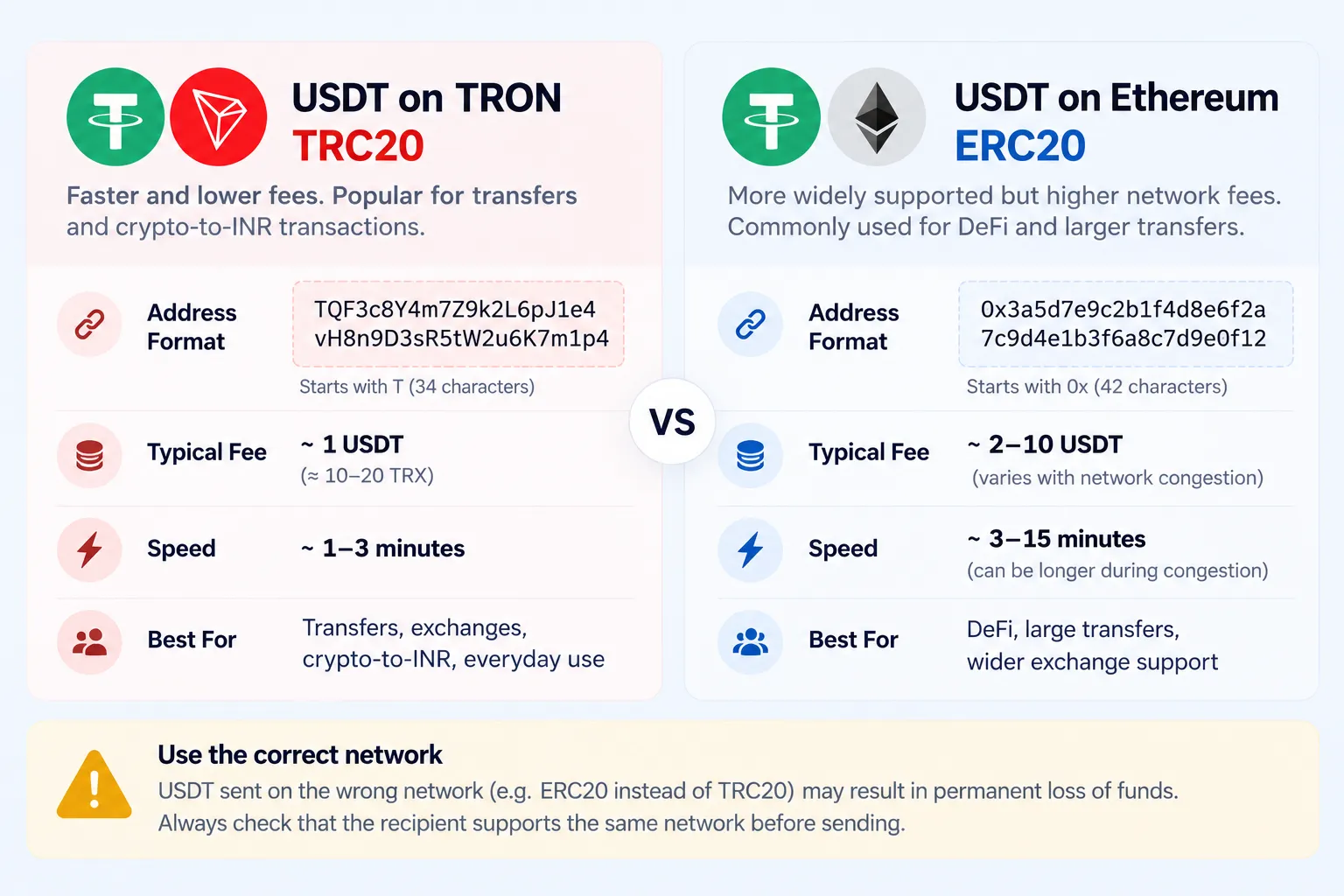
Which should you use to sell USDT for INR?
Use the network your USDT is already on. Moving between chains through a bridge costs extra fees and adds risk. If you're withdrawing from an exchange that offers several networks, TRC20, Solana, Polygon or BSC are usually the cheapest and fastest. On Disburz, pick the network shown in your quote: USDT on TRC20 is accepted today and more networks are being added. See USDT TRC20 to INR.
How to tell which network your USDT is on
- In a wallet (Trust Wallet, MetaMask, TronLink): the network name is shown under the token, such as "USDT · Tron" or "USDT · Ethereum". Each network appears as a separate token.
- On an exchange (Binance, an Indian exchange): the withdrawal screen asks you to pick a network, usually labelled TRX / TRC20, ETH / ERC20 or BSC / BEP20. Your balance can be withdrawn on any network the exchange offers.
- From an address: Tron addresses start with
T; Ethereum, BSC, Polygon and Base addresses all start with0x, so the address alone can't tell those apart.
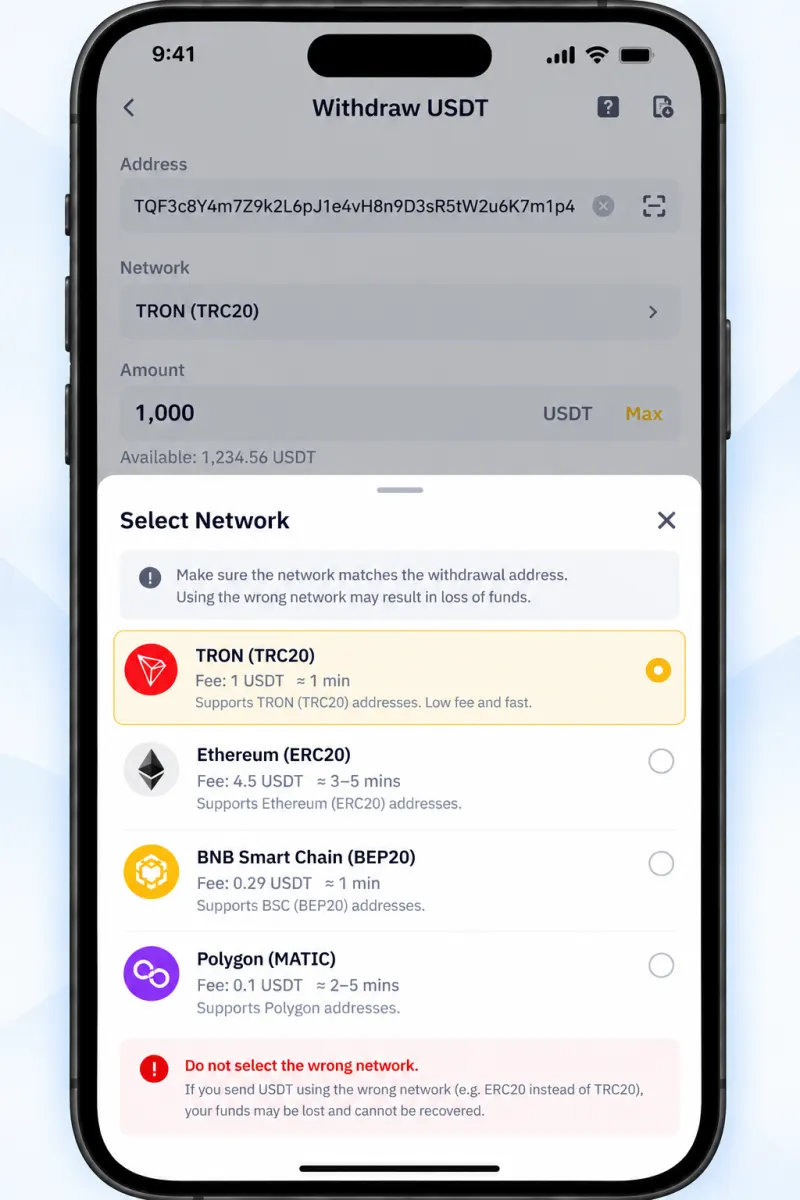
Or paste the address into the USDT address checker.
What it costs to sell small amounts in India
The network fee is a flat cost per transfer, not a percentage. On ERC20 a busy-day fee of several dollars is a large slice of a 100 USDT sale; on TRC20 it's usually around a dollar. So for everyday amounts, sending on TRC20 (or another low-fee network the receiver accepts) leaves more rupees in your bank. For very large amounts the network fee matters less than the rate and the platform's own fees, so compare the final INR you receive.
On Tron, the fee is paid in TRX, not USDT. If your wallet has no TRX, the transfer won't go through. Our Trust Wallet to bank account guide explains how much TRX to keep.
If your USDT is on Ethereum but the receiver wants TRC20
Don't send ERC20 USDT to a Tron address. Most exchanges let you deposit USDT on one network and withdraw it on another: deposit your ERC20 USDT to the exchange, then withdraw it as TRC20. You pay the Ethereum fee once to deposit. Avoid unknown bridges, and send a small test amount first when moving a large sum.
What about other networks?
- Solana — very fast and cheap; addresses are base58 strings with no prefix.
- Polygon and BSC (BEP20) — low fees; addresses start with
0xlike Ethereum, which makes mix-ups easy. Always select the network explicitly. - Base — Ethereum layer-2 with low fees; also
0xaddresses.
0x address is valid on Ethereum, Polygon, BSC and Base. A valid-looking address does not mean the right network — the network selector is what matters. Read what happens if you send on the wrong network.Not sure which network your USDT is on right now? See how to check which network your USDT is on.