Fees · 6 min read
Disburz vs Mudrex vs CoinDCX: Where to Sell USDT for INR (2026)
Disburz vs Mudrex vs CoinDCX for selling USDT in India: fees, TDS, KYC, networks and how INR reaches your bank, checked October 2026.
By Bryan Aaron · Updated
Quick answer
If your USDT is already on Mudrex or CoinDCX and your KYC is done, selling there is simplest: Mudrex lists no fee on USDT to INR, CoinDCX charges a volume-based fee plus GST, and both deduct 1% TDS. If your USDT is in a wallet or on Binance, Disburz pays INR straight to your bank without opening another exchange account.
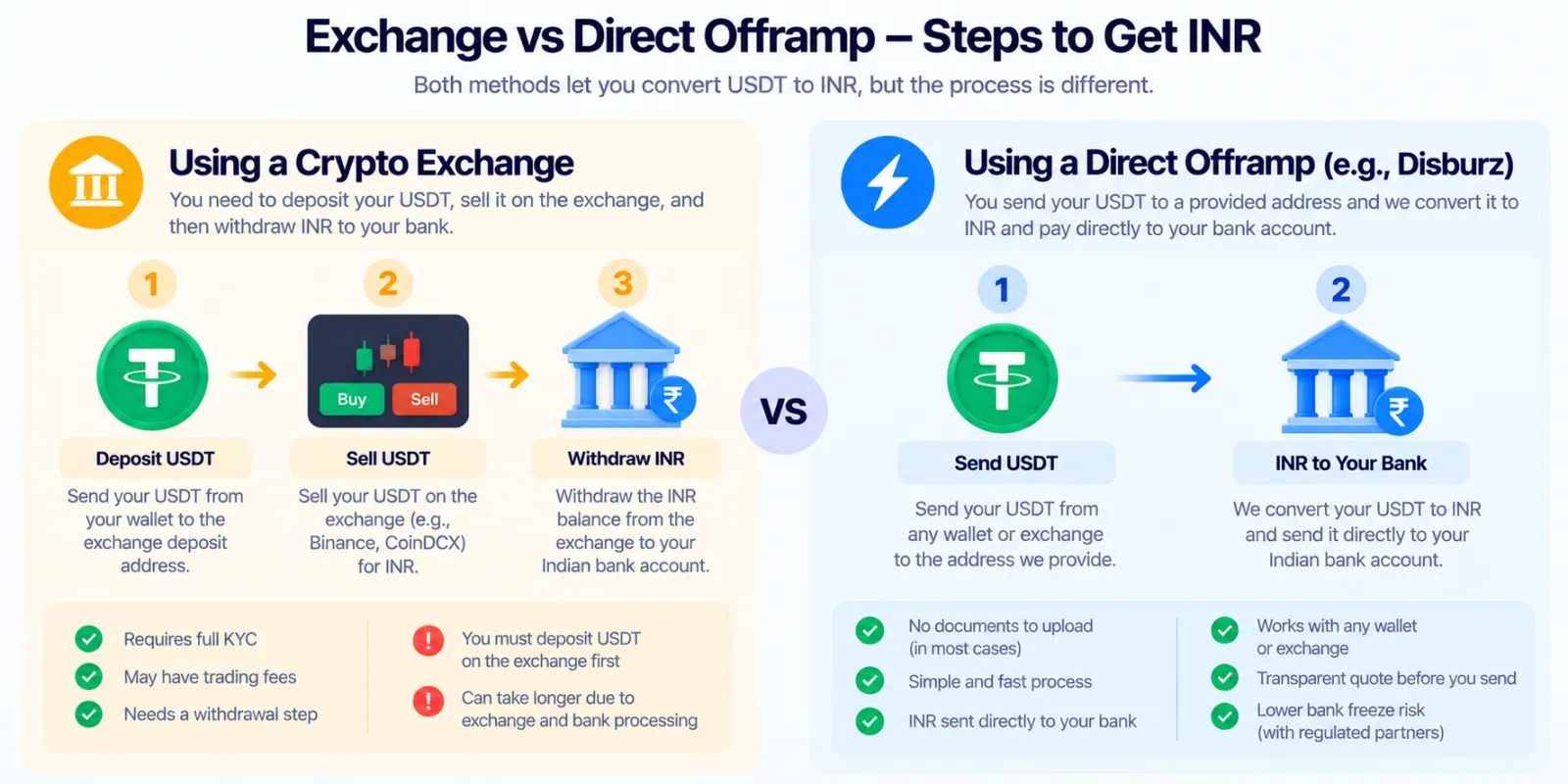
Mudrex, CoinDCX and Disburz all turn USDT into rupees in an Indian bank account, but they work differently. Mudrex and CoinDCX are exchanges: you open an account, complete KYC, deposit USDT, sell it on the platform and then withdraw INR. Disburz is a direct offramp: you send USDT from any wallet or exchange and the rupees go straight to your bank. This page compares what each one charges and who each one suits. Fees were checked on 19 October 2026; Disburz's figures below come from the live quote.
Quick comparison
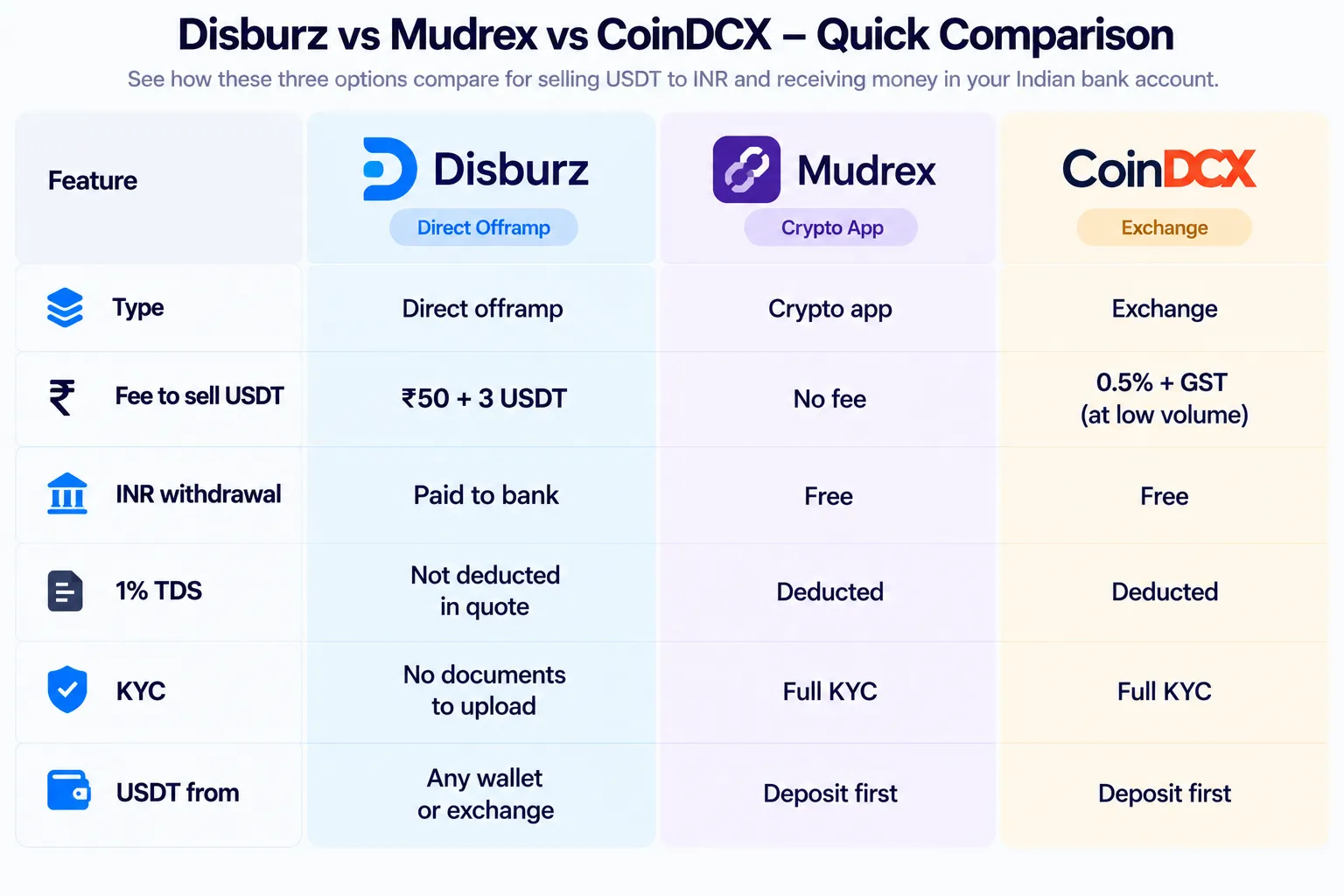
| Disburz | Mudrex | CoinDCX | |
|---|---|---|---|
| Type | Direct offramp | Crypto app / exchange | Crypto exchange |
| Fee to sell USDT for INR | ₹50 fee + 3 USDT network deduction | No trading fee on USDT to INR (per Mudrex) | Trading fee by 30-day volume, reported at 0.5% for the lowest tier, plus 18% GST |
| INR withdrawal fee | None; INR is paid straight to your bank | None (per Mudrex) | None reported |
| 1% TDS on the sale | Not deducted in the quote | Deducted | Deducted |
| Account and KYC | Sign in with email; no documents to upload | Full KYC before INR payout | Full KYC |
| Where your USDT comes from | Any wallet or exchange (Trust Wallet, Binance and others) | Deposit into your Mudrex account first | Deposit into your CoinDCX account first |
| Networks for USDT | TRC20 (Tron) today | Several | Several |
| How INR reaches you | IMPS, NEFT or RTGS from the payout partner, with a UTR | Withdraw from your INR balance | Withdraw from your INR balance |
Fees change, so check each platform's own fee page or sell screen before you sell. More platforms are in the monthly USDT to INR fees table. What you should compare is the final rupee amount that reaches your bank for the same amount of USDT at the same moment, because the rate itself (and the spread built into it) matters as much as any listed fee.
Disburz: fees and who it suits
Disburz charges ₹50 fee + 3 USDT network deduction. For 1,000 USDT that works out to 0.35% (₹338.00) of the value at the quoted rate; for 100 USDT it's 3.52% (₹338.00). Because part of the cost is fixed per order, Disburz is better value for larger amounts and expensive for very small ones. The minimum order is 13.95 USDT.
It suits you if your USDT is in a self-custody wallet like Trust Wallet or on a global exchange like Binance, and you want rupees in your bank without opening another exchange account. Each payout comes with a bank UTR, so you can trace it. The limits: only USDT on TRC20 is live today, and Disburz doesn't hold balances or offer trading.
Mudrex: fees and who it suits
Mudrex says it charges no trading fee and no GST on USDT to INR conversions, and nothing to withdraw INR. 1% TDS is deducted on the sale. You need a verified Mudrex account, and your USDT has to be deposited into it first.
It suits you if you already use Mudrex, or want an app where you can hold crypto, sell and withdraw in one place.
CoinDCX: fees and who it suits
CoinDCX charges a trading fee that depends on your INR trading volume over the last 30 days. Recent fee breakdowns put the lowest tier (under ₹2 lakh a month) at 0.5%, with 18% GST on the fee, falling at higher volumes. INR withdrawals are reported as free, and 1% TDS is deducted on the sale.
It suits active traders who already have a CoinDCX account and trade enough to reach the lower fee tiers.
How to find which one pays you more today
- Pick one amount, for example 1,000 USDT.
- On each platform, open the sell screen and note the INR you'd receive after every fee. On Disburz that's the “You receive” figure in the calculator or quote.
- For exchanges, also count the network fee to move your USDT there, and any INR withdrawal fee.
- Do it within a few minutes, because rates move.
TDS isn't a fee: it's tax paid in advance and credited to your PAN. It does reduce the cash you receive on the day. See crypto tax and TDS in India.
The bottom line
If your USDT is already on Mudrex or CoinDCX and your KYC is done, selling there is simplest. If it's in a wallet or on Binance, a direct offramp saves you opening and verifying another account and pays you from a business, not a P2P stranger. Still weighing P2P? Read the best way to sell USDT in India and whether P2P crypto is legal in India.