How-to · 7 min read
Exness Withdrawal to Indian Bank Account: The USDT Route, Limits and Risks (2026)
Exness stopped taking new Indian clients in July 2025 and is on RBI's Alert List. How existing users move money to an Indian bank via USDT TRC20, and the risks.
By Bryan Aaron · Updated
Quick answer
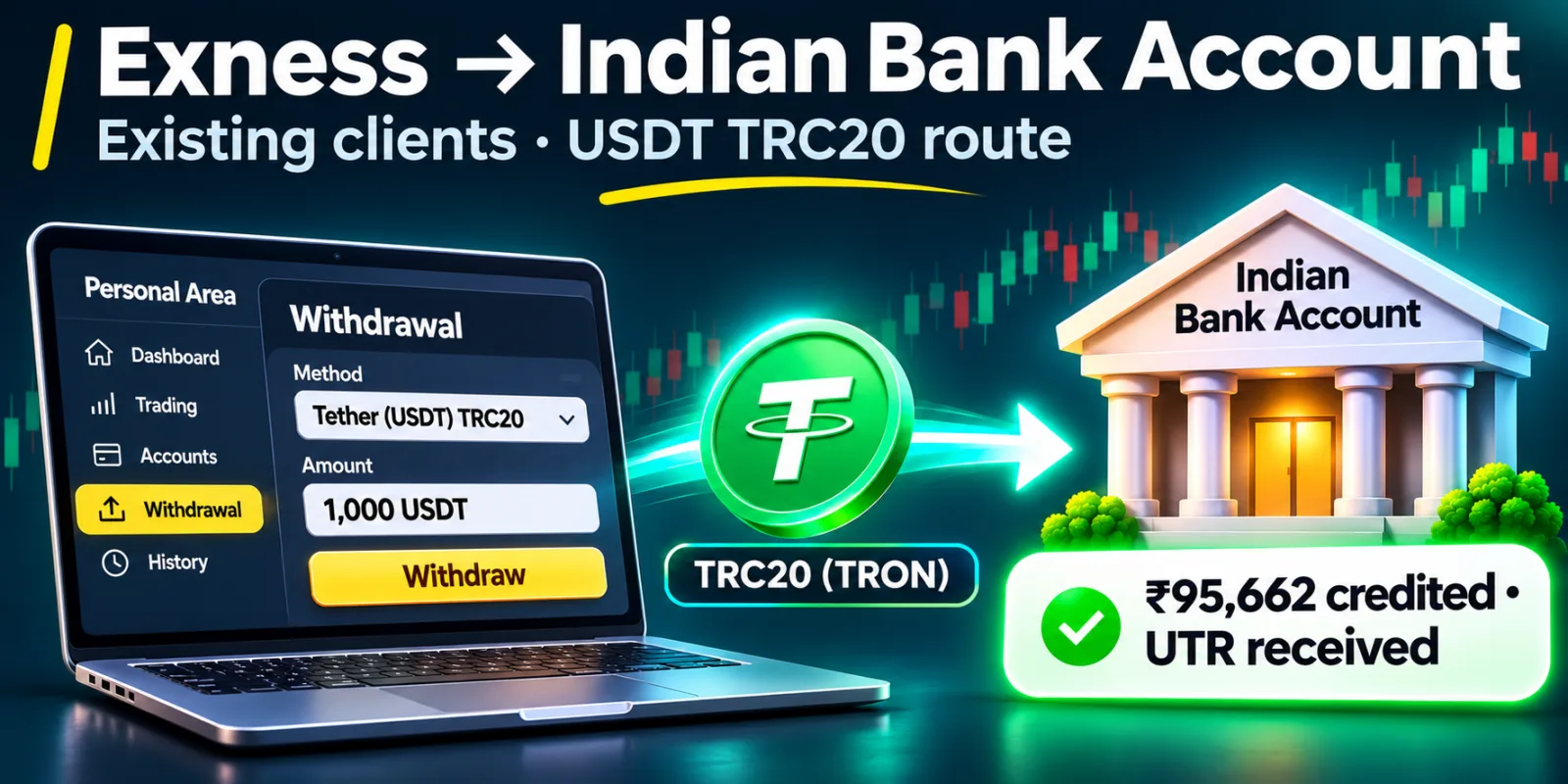
Exness stopped onboarding new Indian clients on 11 July 2025 but still serves existing ones. To get profits into an Indian bank, withdraw as Tether (USDT) TRC20 from your Personal Area to a direct offramp like Disburz, which pays INR by IMPS with a UTR. Exness is on RBI's Alert List of unauthorised forex entities, so know the FEMA risk.
General information, not legal or tax advice. Check your situation with a lawyer or chartered accountant.
You have profit sitting in Exness and want it in your Indian bank account. Exness won't pay rupees straight into most Indian accounts, the bank option comes and goes for Indian users, and local “agent” payouts bring freeze risk. The route most Indian traders use is USDT on TRC20. Here's how it works and what to watch for.
Your withdrawal options from India
| Method | How it works for Indian users | Main risk |
|---|---|---|
| Bank or local transfer | Has been switched off and back on for Indian users; often paid by a local agent | Money from a third party can freeze your account |
| Tether (USDT) TRC20 | Withdraw to a T address, then sell for INR | Picking the wrong network |
| USDT to an exchange, then P2P | Send to Binance or another exchange and sell to buyers | Each buyer is a stranger: the most common cause of frozen accounts |
Before you withdraw: Exness rules that block payouts
- Your own name only. Exness pays only to accounts registered to the exact full legal name on your Exness profile. A friend's wallet or a joint account can get rejected.
- Deposits go back first for some methods. For prepaid cards, Exness requires the deposited amount to be withdrawn in full before any profit.
- Verification complete. Unverified profiles have limited withdrawal options.
- Free margin. You can only withdraw what isn't holding open positions.
Step by step: Exness to your Indian bank account
- Get a Disburz quote for the amount, add your bank account (in your own name), and confirm. Copy the deposit address; it starts with
T. - In your Exness Personal Area, open Withdrawal.
- Choose Tether (USDT) TRC20 as the method. Don't pick USDT ERC20 for a T address.
- Select the trading account, enter the amount, and paste the Disburz address.
- Check the amount that will arrive and confirm with your verification code. Exness says non-instant withdrawals are processed within 24 hours.
- Once the USDT confirms on TRON (about a minute), Disburz pays INR to your bank by IMPS, NEFT or RTGS and emails you the UTR.
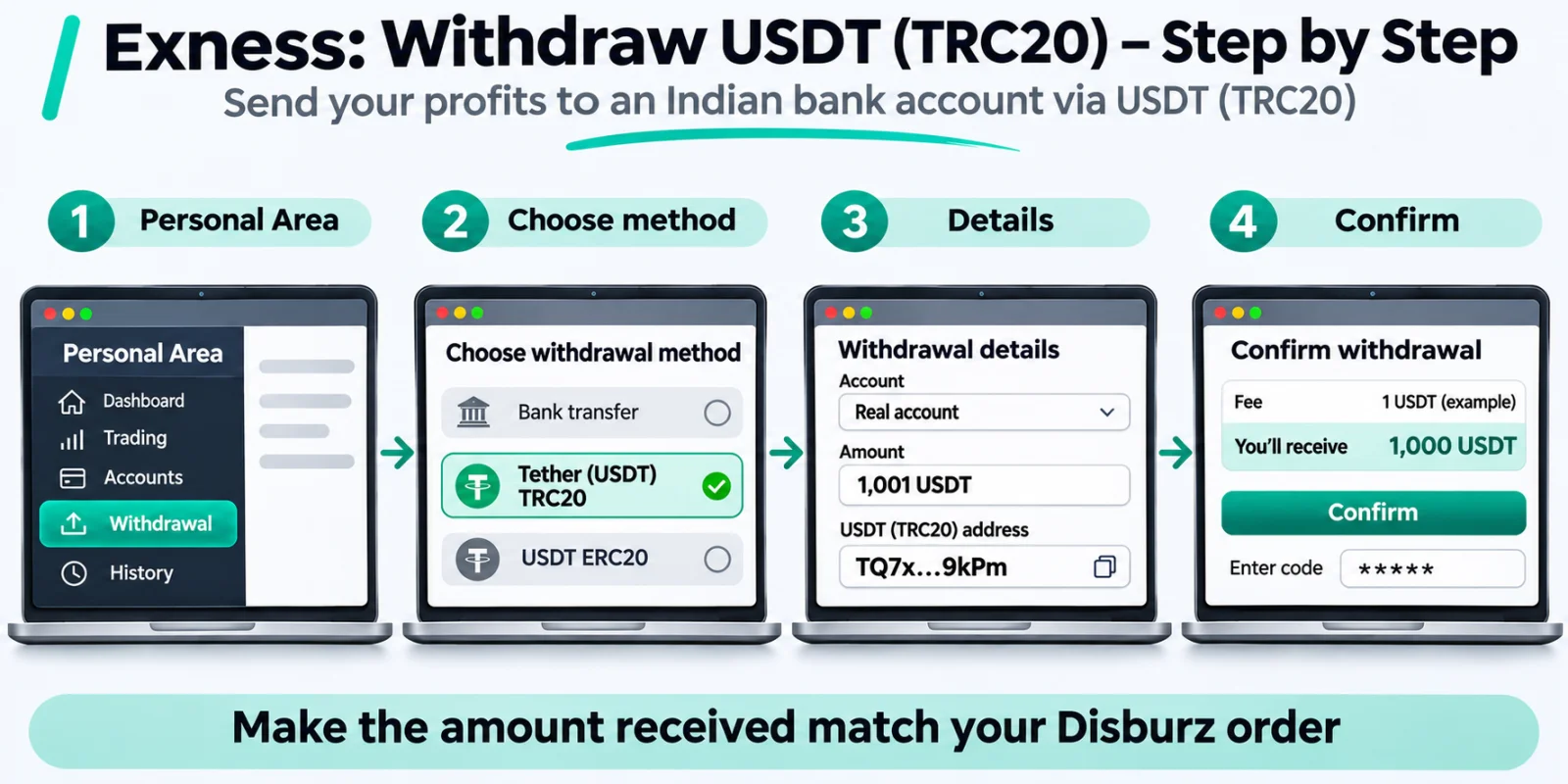
What 1,000 USDT arriving on TRC20 pays at today's quote (fees: ₹50 fee + 3 USDT network deduction):
| Arrives at Disburz | 1,000 USDT (TRC20) |
| Network deduction | − 3 USDT |
| Rate | 1 USDT = ₹96.00 |
| Converted value | ₹95,712.00 |
| Fee | − ₹50.00 |
| Paid to your bank | ₹95,662.00 |
|---|
Why traders get frozen, and how not to
Indian traders on Reddit warn about frozen accounts after Exness withdrawals. Look closely and the cause is almost always the INR leg: a P2P buyer or a local payment agent whose money is linked to a fraud complaint, so police freeze the account that received it.
- Receive INR from one business with a UTR, not from many strangers.
- Don't split a large withdrawal into many small P2P trades.
- Keep Exness statements, withdrawal records and UTRs together.
Already frozen? See bank account frozen after crypto P2P.
Tax on Exness profits
Profits are taxable for a resident whatever the broker, generally as speculative business income at your slab rate. Selling the USDT can also fall under the virtual digital asset rules (30% plus cess on gains, 1% TDS above thresholds). Because the trading itself raises FEMA questions, have a CA prepare your return. Details: forex profits and tax and crypto tax and TDS.
Mistakes to avoid
- Choosing USDT ERC20 for a T address. The network must match. Use the address checker if unsure.
- Paying an “IB” or agent to withdraw for you. Never give anyone your Personal Area login.
- Paying a “release fee” to unlock a withdrawal. Exness takes any fee from the withdrawal itself.
- Opening a new account under someone else's name to get around the onboarding pause. Withdrawals must go to accounts in the account holder's name.
Other routes: any forex broker to an Indian bank, XM, prop firm payouts, Binance to an Indian bank.