
How-to · 7 min read
How to Withdraw a Prop Firm Payout to an Indian Bank Account (USDT to INR)
Got a prop firm payout in USDT? How to get it into your Indian bank account without P2P or a bank freeze, which network to use, and how the payout is taxed.
By Bryan Aaron · Updated
Quick answer
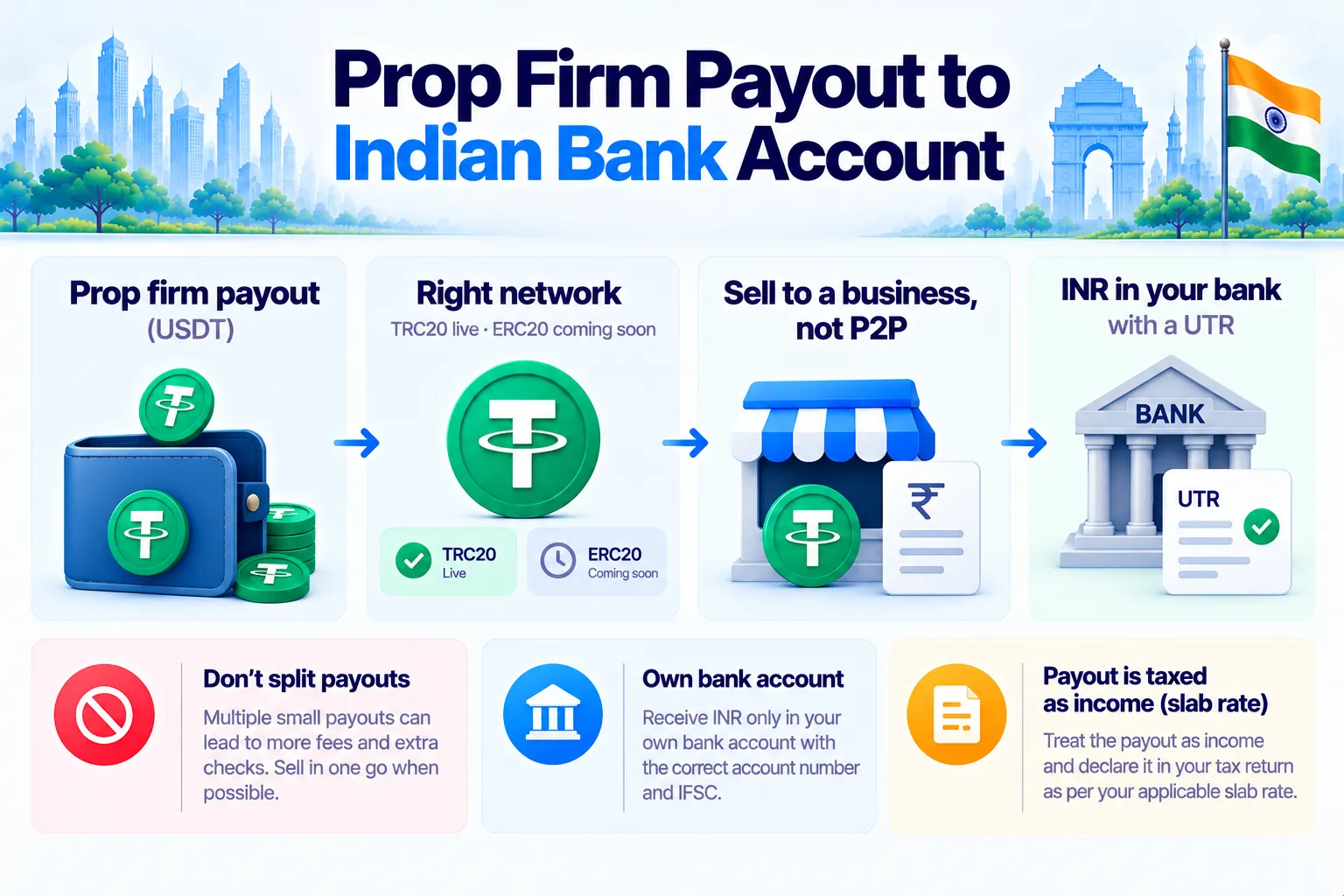
To get a prop firm payout into an Indian bank account, take it in USDT, make sure it's on a network your offramp accepts (TRC20 on Disburz today), sell it to a business rather than a P2P stranger, and receive INR by IMPS, NEFT or RTGS with a UTR. The payout is usually income at your slab rate; confirm with a CA.
You passed the challenge, traded the funded account and got your first payout. Now comes the part most traders worry about more than the trading: getting the money into an Indian bank account without a P2P stranger, a frozen account or a tax mess. This guide covers the whole route.
How prop firms pay Indian traders
Most prop firms that fund Indian traders pay profit splits in crypto, usually USDT, either directly or through a payout platform such as Rise. Some also offer bank transfer or Wise. Crypto is popular because it's fast and works from any country, but it leaves you with USDT that you still need to turn into rupees.
If your firm can pay you by bank transfer in a normal currency, that route avoids crypto entirely. Compare the costs in Wise vs USDT to India. If you're paid in USDT, read on.
Step 1: Get the payout on the right network
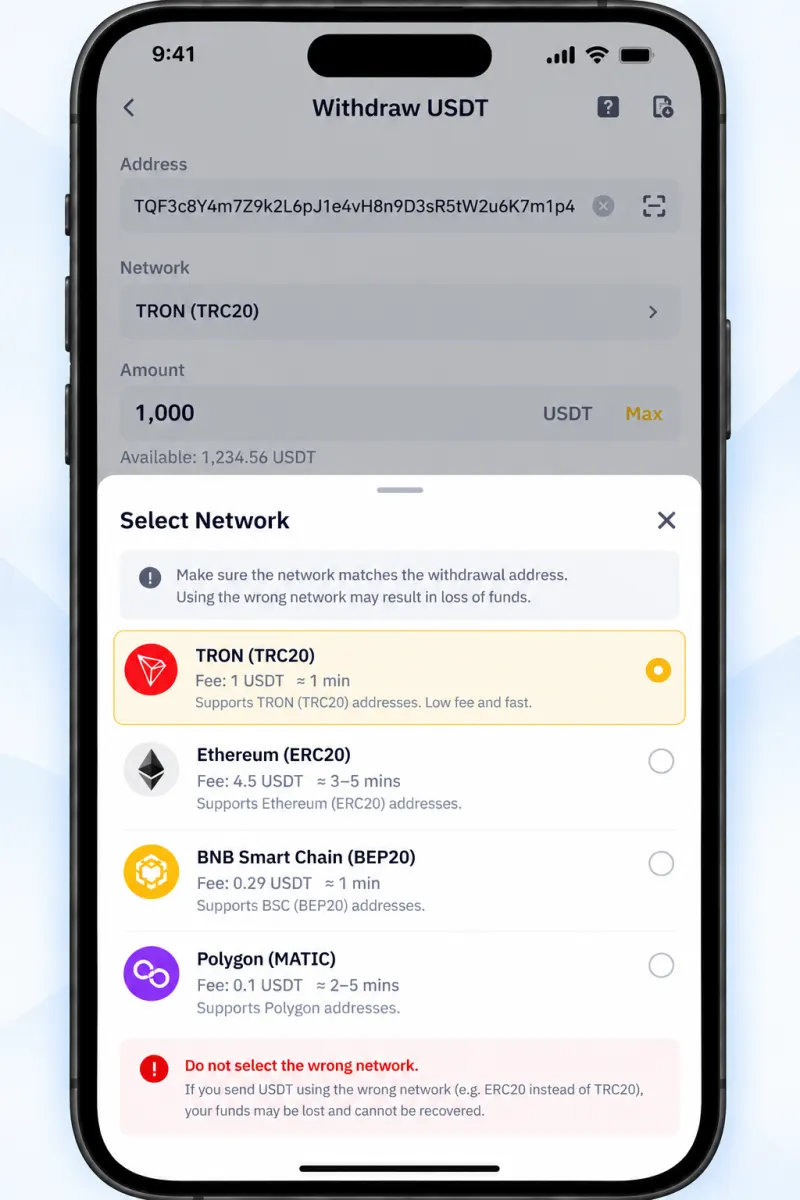
USDT exists on many networks, and a payout arrives on whichever one your firm or payout platform uses: Tron (TRC20), Ethereum (ERC20), Arbitrum, BNB Smart Chain and others. The network matters, because USDT can only be sold where that network is accepted.
- On Disburz, USDT on TRC20 is live today, and ERC20 is coming soon. If you can choose, take the payout on TRC20.
- Paid on another network, such as Arbitrum? Receive it at an exchange that supports that network, then withdraw it as USDT on TRC20. Check the exchange's withdrawal fee first.
- Check the token, not just the name. Some platforms pay a bridged or wrapped version of USDT (for example “USDT0”) that a wallet may not show by default and some platforms don't accept. Confirm what you'll receive before you request the payout.
- Never send USDT on one network to an address for another. See what happens if you send on the wrong network, and check any address with the USDT address checker.
Step 2: Sell the USDT to a business, not a P2P stranger
This is the step that decides whether your bank account stays safe. On P2P, a stranger pays you rupees, and if that money came from a scam victim, police can freeze your account even though you did nothing wrong. Prop traders are hit hard by this because payouts are large and regular. See bank account frozen after P2P.
Sell to a business that pays from its own account instead: an Indian exchange or a direct offramp. On Disburz you get a quote with every fee shown, send the USDT on TRC20, and our payout partner Trans Ramp pays INR to your bank by IMPS, NEFT or RTGS, with the UTR emailed to you.
Worked example: a $1,000 payout (live)
| Arrives at Disburz | 1,000 USDT (TRC20) |
| Network deduction | − 3 USDT |
| Rate | 1 USDT = ₹96.00 |
| Converted value | ₹95,712.00 |
| Fee | − ₹50.00 |
| Paid to your bank | ₹95,662.00 |
|---|
These numbers come from today's live quote and update with it. Larger payouts go by RTGS; see how to sell a large amount of USDT.
Step 3: Don't split the payout to “stay safe”
A common tip in trading groups is to split a payout into many small sales. It doesn't make you safer. Banks watch for exactly that pattern, and if the small sales go to P2P buyers, each one is another chance of receiving scam money. One payout, sold in one or two orders to a business, with a UTR for each, is the clean pattern. More in how much USDT you can sell without bank problems.
Step 4: Use the right bank account
- Always your own name. Never take payouts into a friend's or family member's account.
- Savings or current both work for receiving INR. If prop trading is now your main income, a current account suits large, regular credits better.
- Keep your bank profile honest and up to date. If your occupation or income has changed, for example from student to trader, tell your bank. Credits that match your profile raise fewer questions.
Step 5: Keep a proof file for every payout
- The payout statement or certificate from the prop firm, and the payout platform's receipt
- The blockchain transaction ID for each USDT transfer
- The sale's order details, the INR received and the UTR
- Receipts for the challenge fees you paid
With this file, a question from your bank or your CA takes one email to answer. Before you send, run through the checklist before you sell USDT.
How prop firm payouts are taxed
This is the most common question from prop traders, and the answer is less scary than the “30% crypto tax” headlines suggest. Most CAs split it into two events:
- When you receive the payout, it's income for your trading work. Its INR value on that day is usually treated as business or professional income, taxed at your normal slab rate, not at 30%. Ask your CA whether challenge fees can be claimed as expenses against it.
- When you sell the USDT, any gain over that value is a gain on a virtual digital asset, taxed at a flat 30% plus cess. If you sell soon after receiving it, the gain is usually small.
Traders with business income usually file ITR-3 and fill in the VDA schedule for the sale. If 1% TDS was deducted when you sold, it shows in your Form 26AS / AIS. Full rules are in crypto tax and TDS in India, and the same two-step logic is explained for freelancers in getting paid in USDT as a freelancer.
What about GST?
Whether GST applies to prop firm income, and whether a crypto payment counts as an export of services, isn't settled. If you're registered for GST or your payouts are large, settle this with your CA before you file.
The short version
Take the payout in USDT on a network your offramp accepts (TRC20 on Disburz today, ERC20 coming soon), sell it to a business that pays from its own account, receive it in your own bank account with a UTR, keep the proof, and file it as income with your CA. No P2P, no splitting, no surprises. For profits from your own trading account rather than a funded one, see cashing out crypto trading profits.