
How-to · 8 min read
Bitget to Indian Bank Account: Withdraw USDT and Get INR (2026)
Bitget doesn't pay INR to Indian banks, paused Indian sign-ups and was hacked in 2026. Withdraw USDT on TRC20 and get rupees in your bank without P2P.
By Bryan Aaron · Updated
Quick answer
Bitget doesn't pay INR into Indian bank accounts; its INR option is P2P. To get rupees without P2P, convert to USDT, use Assets → Withdraw → On-Chain Withdrawal, pick TRC20 and send to a direct offramp like Disburz, which pays INR by IMPS with a UTR. Withdrawals for existing Indian users are open, fully restored since 2 October 2026 after the hack.
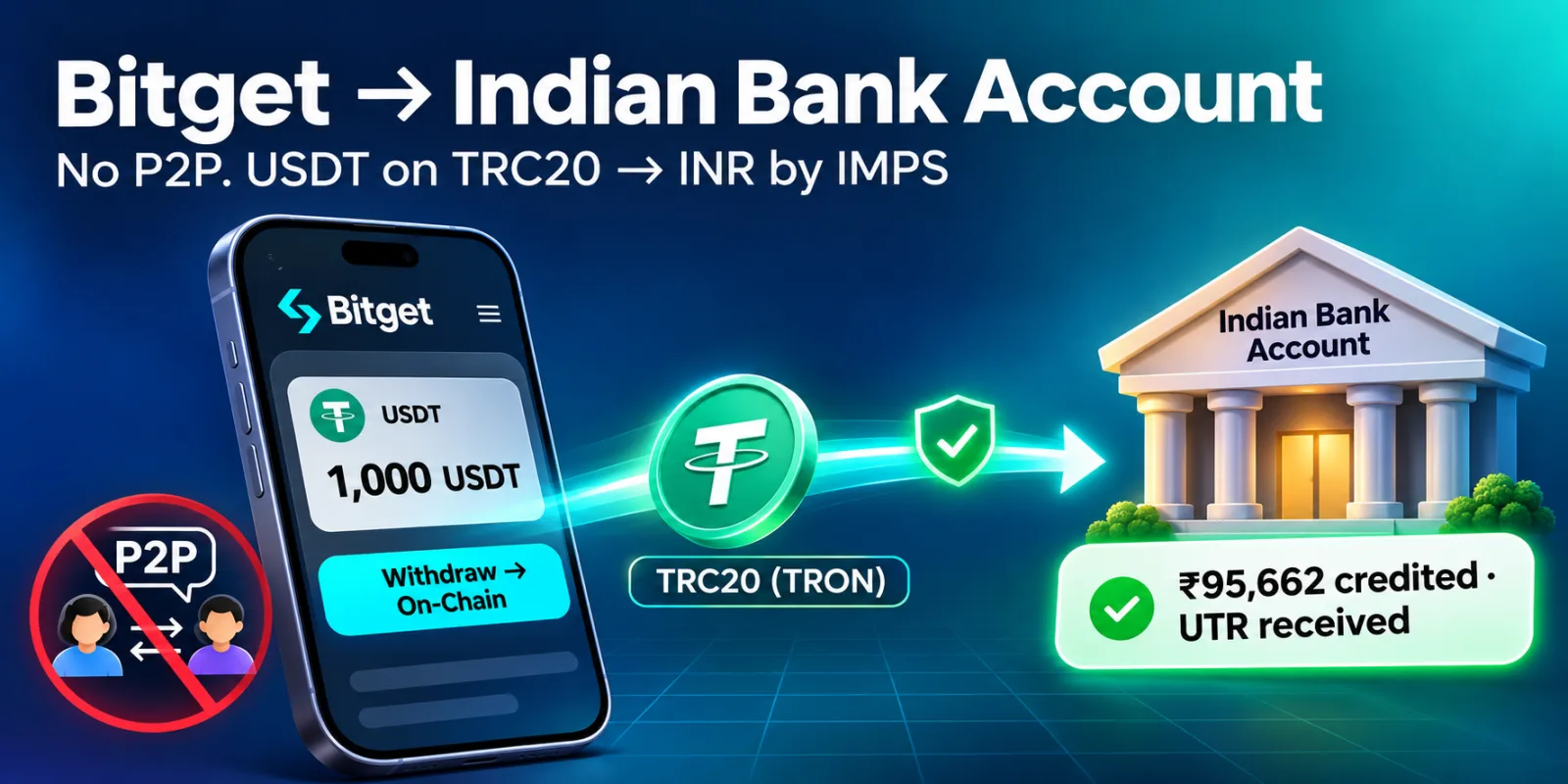
Bitget doesn't send rupees to Indian bank accounts. Look for INR in the app and you end up on P2P, where a stranger pays you by UPI or bank transfer. You can skip that: withdraw USDT on the TRON network to a business that pays INR from its own bank account.
Can Indian users still use Bitget?
Existing users can. On 4 February 2026 Bitget announced that it would stop new sign-ups from India from 6 February 2026, 4:00 PM IST, while it completes the registration India's Financial Intelligence Unit (FIU-IND) requires. For people who registered and verified before that date, Bitget says:
- deposits, trading and withdrawals stay available;
- funds aren't frozen because of the pause;
- any future change to withdrawals will be announced in advance.
Is Bitget FIU-registered? Bitget's own FAQ describes the sign-up pause as a step to complete the registration FIU-IND requires, so treat it as not yet registered until FIU-IND's list or a Bitget announcement says otherwise.
Is Bitget safe after the September 2026 hack?
On 24 September 2026, attackers moved about $388 million out of Bitget's hot and warm wallets, using credentials stolen through a flaw in a third-party security product. Bitget stopped all withdrawals the same evening, then reopened them in stages:
| Date (2026) | Withdrawals reopened |
|---|---|
| 28 September | BTC |
| 29 September | ETH, on Ethereum and EVM networks |
| 30 September | USDT, including TRON (TRC20) |
| 2 October | All other coins, fiat and P2P |
Bitget says cold wallets and private keys weren't affected, user balances stayed the same, and its Protection Fund covers the loss. Deposits and trading kept running throughout. Even so, for over a week people couldn't move their money out. That's the real lesson: an exchange balance is only as available as the exchange lets it be. Withdraw what you plan to spend instead of keeping it on any exchange. Five weeks later Binance was hacked too: see the Binance hack 2026 updates.
Your options for turning Bitget USDT into INR
| Route | Who pays your INR | Main risk |
|---|---|---|
| Bitget P2P | A stranger, by UPI, IMPS or bank transfer | Money linked to fraud can freeze your bank account |
| P2P paid by cash deposit (CDM) or e-Rupee | A stranger, at a cash machine or by digital rupee | Still P2P: same fraud and freeze risk, plus cash deposits are harder to explain to your bank |
| Send USDT to an Indian exchange (CoinDCX and others) and sell there | The exchange, after you sell on its order book | 1% TDS deducted on the sale, exchange fees, and possible deposit checks |
| Bitget Card at an ATM (where offered) | Your card, from your crypto balance | Card and ATM fees, limits, and a messy record for tax |
| Withdraw USDT on TRC20 to Disburz | Disburz's payout partner, by IMPS, NEFT or RTGS | Sending on the wrong network (avoidable, see below) |
P2P buyers often quote more per USDT than a business payout. The gap is what you're paid for taking the freeze risk. Bitget's own help centre says many of its P2P merchants have had bank accounts frozen after trading with fraudulent users, including “chain freezes”, where the buyer's money came from someone else they cheated. Read bank account frozen after crypto P2P before you choose.
Before you withdraw: three things Bitget checks
- KYC: your account must be verified.
- Google Authenticator: Bitget requires it before any withdrawal.
- Email or phone: one must be verified, because each withdrawal is confirmed with a code.
Step by step: Bitget to your bank account
- Convert to USDT on Bitget's spot market if you hold another coin or have futures profit.
- Get a Disburz quote for the amount, add your bank account, and confirm. Copy the deposit address (it starts with
T) and note the exact USDT amount. - In the Bitget app, tap Assets → Withdraw, choose USDT, then On-Chain Withdrawal.
- Paste the address and select the TRC20 network. Make sure the network matches the
Taddress before going on. - Enter the amount. Bitget shows the fee and the amount that will be credited. Make the credited amount match your Disburz order.
- Tap Withdraw and confirm with your email, Google Authenticator or SMS code.
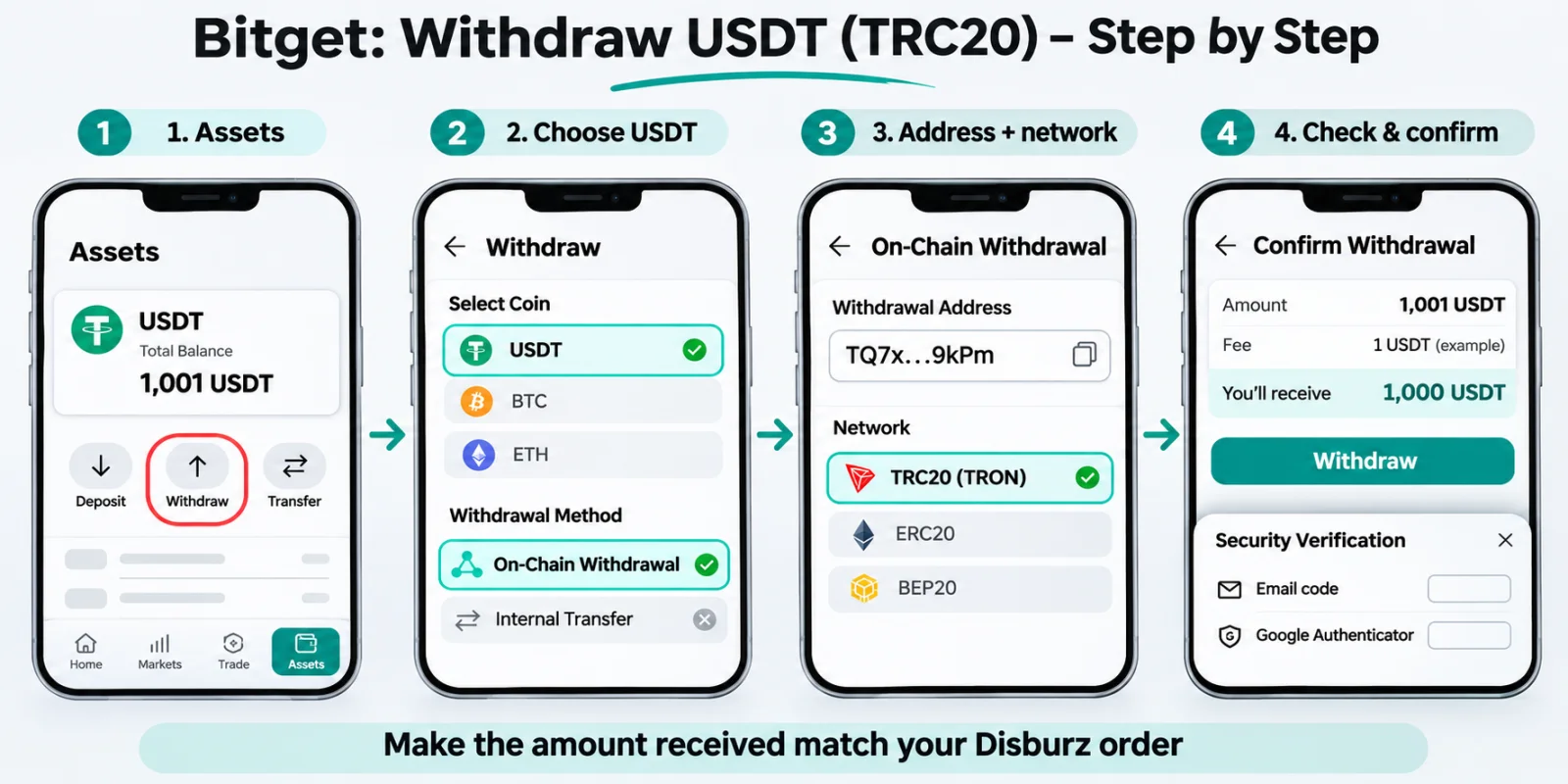
Bitget says most withdrawals are processed within a few minutes. You can follow yours under Assets → Spot → History → Withdrawal. Once the USDT reaches TRON, Disburz detects it, counts the confirmations (about a minute) and pays INR to your bank, then emails you the UTR.
What 1,000 USDT arriving on TRC20 pays at today's quote (fees: ₹50 fee + 3 USDT network deduction):
| Arrives at Disburz | 1,000 USDT (TRC20) |
| Network deduction | − 3 USDT |
| Rate | 1 USDT = ₹96.00 |
| Converted value | ₹95,712.00 |
| Fee | − ₹50.00 |
| Paid to your bank | ₹95,662.00 |
|---|
What it costs
Two fees: Bitget's withdrawal fee for USDT on TRC20, shown on the withdrawal screen (Bitget says TRC20 is generally cheaper than ERC20), and Disburz's fees, which the quote shows with the exact INR before you send. There's nothing else on the Disburz side, and no documents to upload.
Using Bitget Wallet instead of the exchange?
Bitget Wallet is a separate self-custody app, and it supports USDT on TRON. Sending TRC20 USDT from it needs TRX for the network fee (energy and bandwidth), so keep some TRX in the wallet. Then send the USDT on TRON to your Disburz deposit address, just as from Trust Wallet. The wallet's built-in sell option goes through a third-party provider, so check whether it pays INR to an Indian bank before you rely on it.
Mistakes to avoid
- Using an internal transfer. Bitget can send to another Bitget user off-chain. Disburz needs a real On-Chain Withdrawal on TRON.
- Choosing BEP20 or ERC20 for a T address. The network must match the address. Not sure? Use the address checker, or read how to check your USDT network.
- Withdrawing futures profit without converting first. Move it to your spot balance as USDT, then withdraw.
- Using a VPN or someone else's account to get around the sign-up pause. It breaks Bitget's terms and can get the account restricted with your money inside.
Tax: gains on crypto are taxed at a flat 30% plus cess, whichever way you cash out, and you report them in your ITR as income from virtual digital assets. Keep your Bitget trade history and the UTR of every payout. Details: crypto tax and TDS in India.
Made the money trading? Read how to cash out crypto trading profits for the records to keep. Selling a lot? Read how to sell a large amount of USDT.
Other exchanges: Binance, Bybit, OKX, KuCoin, MEXC, Gate.
Sources
- Bitget Support: FAQ – Temporary Restriction of Services in India (4 February 2026)
- Bitget Support: How to Withdraw Cryptocurrency from Bitget – Mobile App Guide
- Bitget Support: What Is the Deposit/Withdrawal Fee?
- Bitget: Security Incident (September 2026) – timeline, impact and official updates
- Bitget Support: Completing the phased resumption of token withdrawals, fiat and C2C services (2 October 2026)
- Bitget Support: What is the Order acceptance feature for P2P merchants? (bank freezes after P2P)